Balanced Dog Training vs. Positive Only: What's the Difference?
If you've spent any time researching dog training, you've probably run into this debate. It shows up in Facebook groups, Reddit threads, and even between trainers at the park. Positive only vs. balanced training — two camps, strong opinions, and a lot of confusion for dog owners who just want to know what actually works.
After 25 years of training dogs in Portland — everything from family pets to severe aggression cases — I've watched this conversation evolve. And I think most dog owners deserve a straight, honest answer instead of marketing spin from either side.
So here's my personal take.
What Is Positive-Only Dog Training?
Positive-only training (also called force-free or R+ training) is built around one core principle: reward the behaviors you want, ignore or redirect the behaviors you don't. No corrections, no aversives, no physical or verbal pressure. The dog learns that good choices lead to good things — treats, praise, play — and is never punished for making a wrong one.
In the right hands, this approach works beautifully for a lot of dogs. Puppies, food-motivated dogs, dogs learning basic obedience, dogs with no major behavioral issues — positive-only can get excellent results. And it's genuinely kind. That matters.
The limitation? For some dogs, especially those dealing with aggression, reactivity, anxiety-driven behavior, or deeply ingrained habits, reward-only training isn't enough on its own. When a dog is in a heightened emotional state — threshold, triggered, over-aroused — they often can't access the food reward at all. The treat isn't the most important thing in the room anymore. And without any other tool in the toolbox, the trainer is stuck.
What Is Balanced Dog Training?
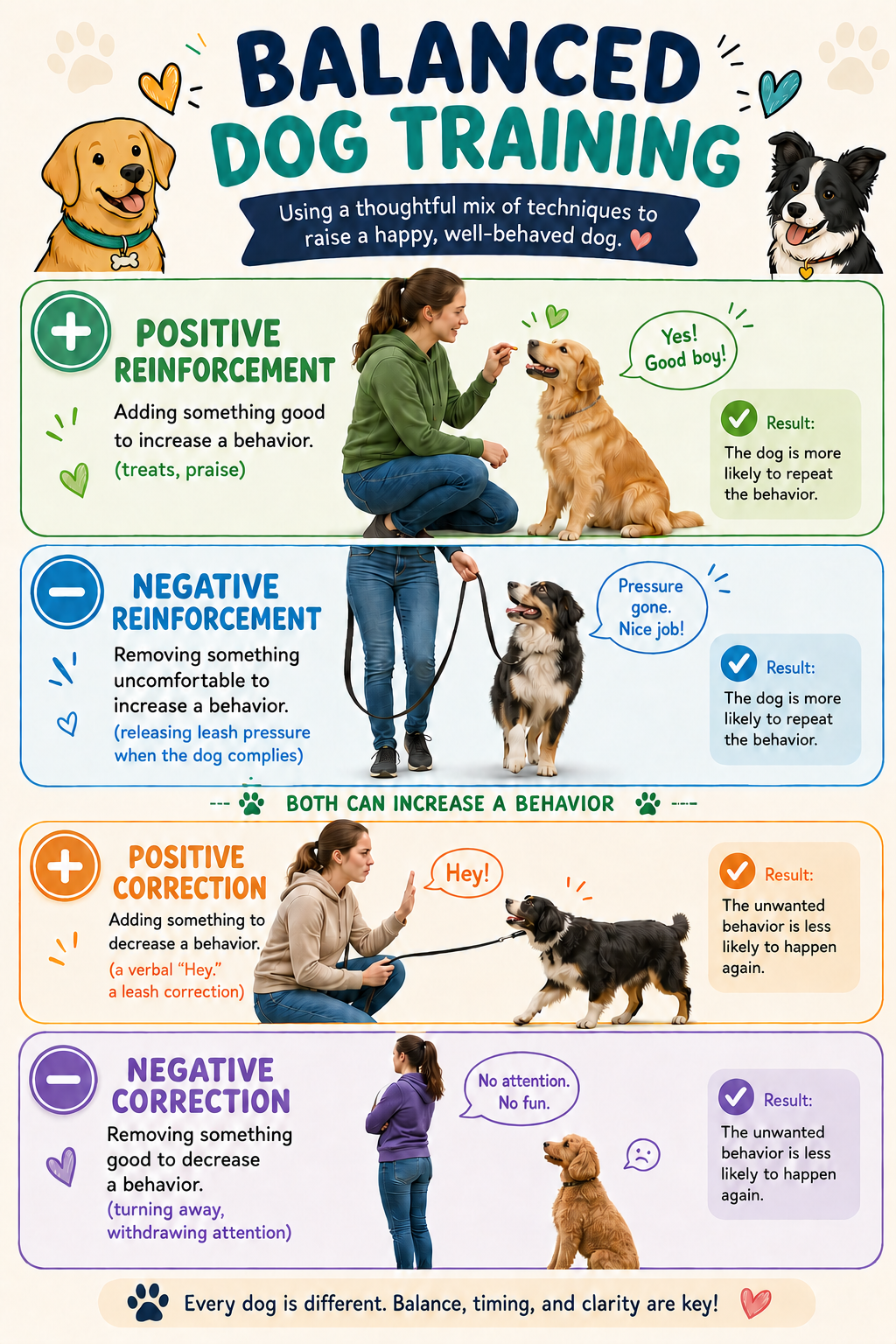
Balanced training uses the full picture of how dogs learn. In behavioral science terms, it works with all four quadrants of operant conditioning:
Balanced Dog Training
Positive reinforcement — adding something good to increase a behavior (treats, praise)
Negative reinforcement — removing something uncomfortable to increase a behavior (releasing leash pressure when the dog complies)
Positive correction — adding something to decrease a behavior (a verbal "hey," a leash correction)
Negative correction — removing something good to decrease a behavior (turning away, withdrawing attention)
Balanced doesn't mean harsh. It doesn't mean old-school dominance theory, shock collars on every dog, or punishing a dog for being a dog. Done well, it means reading each dog as an individual, using the least amount of pressure needed to communicate clearly, and pairing corrections with rewards so the dog understands both what you don't want and what you do.
The goal is always the same: a dog who's calm, clear, and confident — not one who's suppressed or afraid.
The Cases That Show You the Difference
Here's where I'll get specific, because I think examples matter more than theory.
I've worked with hundreds of dogs over the years — including 15 years running a rescue operation where I placed dogs in new homes. I've seen dogs come through my door that other trainers had already given up on. Dogs who'd bitten people. Dogs so anxiety-ridden they couldn't leave the house. Dogs that had been through months of positive-only training with no real progress.
The thing I see most often: a dog who's been rewarded into compliance in low-distraction environments, but falls completely apart the moment the stakes go up. The leash goes on, a dog appears across the street, and suddenly the training disappears. Why? Because no one ever taught the dog that they still had to make the right choice even when they didn't want to.
Balanced training gives you that. A correction — delivered calmly, clearly, and proportionally — communicates to the dog: that choice isn't available to you. Followed immediately by a reward when they make the right choice, the dog learns both edges of the boundary. That clarity is actually what creates a calm, stable dog.
I'm not anti-positive-only training. I use positive reinforcement constantly — it's the foundation of everything I do. But I won't pretend that rewards alone can rehabilitate a dog with severe aggression or deep-rooted reactivity. That's not honest, and dog owners deserve honesty.
Why This Debate Gets Heated (And What It Misses)
The online discourse around this topic often turns into an all-or-nothing fight. Positive-only trainers accuse balanced trainers of being cruel. Balanced trainers accuse positive-only trainers of being naive. Meanwhile, actual dog owners are stuck in the middle, not knowing who to trust.
Here's what I think the debate misses: it's not about the method, it's about the dog in front of you.
A skilled trainer — no matter what their philosophical leaning — is reading the individual dog, adjusting in real time, and asking: what does this dog need to understand what I'm asking? What's going to be clearest, kindest, and most effective for this animal, today, in this situation?
That's what 25 years of experience actually teaches you. Not allegiance to a camp. The ability to read a dog.
What This Means for Your Dog
If your dog is dealing with any of the following, it's worth having an honest conversation with a trainer who has experience beyond reward-based work:
Aggression — toward people, other dogs, or in resource-guarding situations
Reactivity — lunging, barking, or inability to focus around triggers
Anxiety-driven or obsessive behaviors — destructive chewing, separation anxiety, compulsive behaviors
No recall — a dog who ignores you when something more interesting is present
Prior training that "worked at home" but not in real life
These aren't dogs that failed positive training. These are dogs that need more nuance — more tools, more clear communication, more experience behind the leash.
That's the work I do. It's the work I've always done.
What to Ask Any Trainer Before You Hire Them
Regardless of method, here are the questions I'd ask:
What experience do you have with dogs like mine? A trainer who specializes in anxious puppies and a trainer who specializes in aggression rehab are not interchangeable.
Can you explain why you're using a particular tool or technique? Good trainers can answer this clearly. "Because it works" isn't an answer.
What does success look like at 4 weeks? At 8 weeks? You should have a roadmap, not a vague promise.
Will you teach me, not just train my dog? The best training in the world doesn't stick if the owner doesn't learn how to maintain it.
Have you worked with cases that looked like mine? Ask for specifics. Real experience shows.
FAQ: Balanced Training in Portland
Is balanced dog training safe?
Yes — when done by an experienced trainer who uses the minimum effective level of pressure for each dog. Balanced training in the wrong hands can cause problems, just like any other method. That's why experience and credentials matter.
Isn't positive-only training more humane?
Humane means what's genuinely in the dog's best interest — not what feels best to the human watching. Leaving a dog in a state of chronic anxiety, reactivity, or aggression because we won't use any correction is not humane. Clarity, structure, and appropriate consequences delivered calmly are not cruel.
My dog has been through positive-only training and still has issues. Now what?
This is one of the most common situations I see. It doesn't mean the previous trainer failed — it may just mean your dog needs more. Come in for a temperament test and let's see where we are. No judgment, just a fresh read on your dog.
Does balanced training use shock collars?
Not automatically, no. Balanced training is a philosophy, not a specific tool. Many balanced trainers, including myself, use prong collars, e-collars, slip leads, and flat collars depending on the dog, the behavior, and the situation. Every tool is introduced carefully and humanely.
How long does it take to see results with balanced training?
For most dogs, you'll notice real change within the first 2–4 sessions. Significant behavioral rehabilitation takes longer — typically 8+ sessions — and always involves teaching the owner alongside the dog.
Where can I get balanced dog training in Portland, OR?
Von Dubinhaus Dog Training Services has been Portland's go-to for balanced training since 1999. Call us at (503) 936-0641 or visit vondubinhaus.com to schedule your temperament test.
Ready to Get Real Results?
If you've been going in circles with your dog — or if you've been told there's nothing that can be done — I'd encourage you to come in before you give up. I've seen dogs turn around that I wouldn't have believed possible if I hadn't seen it myself.
That's not marketing. That's just 25 years of showing up.
Von Dubinhaus Dog Training Services
📍 14200 SE Woodward St, Portland, OR 97236
📞 (503) 936-0641
🌐 vondubinhaus.com
Start with a temperament test — $45 for new clients. $20 for each additional dog.