Why Summer Is the Best Time to Train Your Dog in Portland
Most people assume summer is a bad time for dog training. Life gets busy. The kids are home. There are trips, barbecues, hiking plans, and about a hundred other things pulling at your attention. The dog's training can wait until fall, right?
Summer isn't just a fine time to train your dog. In my experience, it's the best time. And if you've been putting it off, you're sitting on one of the best windows you'll have all year.
Here's why.
Portland Summers Are a Training Dream
Let's start with the obvious: the weather ☀️
From July through September, Portland is stunning. Dry, warm, long days — the kind of conditions that make outdoor training genuinely enjoyable for both you and your dog. Compare that to seven months of gray drizzle, and you'll understand why I tell clients to take advantage of summer while it's here.
Dog training is most effective when it happens in real-world environments — parks, sidewalks, parking lots, trails. The outdoors is where the real work gets done, where distractions exist, where your dog actually learns to listen when it matters. And summer in Portland makes getting outside easy, consistent, and sustainable.
Rain is a barrier most people don't acknowledge. When it's cold and wet and getting dark at 4:30pm, outdoor practice sessions drop off fast. The homework doesn't get done. The skills don't stick. Summer removes that friction entirely.
More Time Together = Faster Progress
Here's something that doesn't get talked about enough in dog training: you are the variable that matters most.
I can work with a dog for an hour and make real progress. But if you're not reinforcing what we do between sessions — if you're not practicing, not holding the structure, not reading your dog — that progress fades. Dog training is a partnership. The owner is always part of the equation.
Summer changes that equation in your favor. Whether you're working from home more, taking time off, or just generally spending more hours outside with your dog, the summer months give you more face time with your animal. And more face time means more practice repetitions, more consistency, and faster results.
I've seen dogs who'd been struggling with the same issues for two or three years finally turn a corner over a single Portland summer — not because anything magic happened, but because their owners were finally home enough to do the work.
Summer Exposes Everything (Which Is Exactly What You Want)
One of the trickiest things about dog training is that a lot of dogs behave perfectly fine at home, in quiet environments, with no distractions. Put them on a crowded street, at a park with kids and bikes and other dogs, or in a busy parking lot, and suddenly everything you thought they knew evaporates.
Summer is full of those high-distraction moments. Farmers markets. Trails. Patios. Street fairs. Neighborhood kids on bikes. Other dogs everywhere.
For a dog with behavioral issues — reactivity, leash pulling, poor recall, anxiety around strangers — that can sound stressful. But here's the reframe: those moments are the classroom. That's where the real training happens. You can't fix a reactive dog by practicing only in your backyard. You have to get them into the environment that challenges them, with the right guidance, and teach them a different response.
Summer hands you an endless supply of training scenarios. That's not a problem — that's an opportunity.
The Best Dogs I've Ever Worked With Were Summer Dogs
I don't mean that literally. I mean the most dramatic turnarounds I've seen — the dogs that came in reactive, anxious, aggressive, or completely unmanageable and left as balanced, calm animals — a disproportionate number of those happened over summer training programs.
Part of it is the weather and the consistency I mentioned. But part of it is also this: summer has an end date. There's a natural built-in urgency. You want your dog trained before school starts again, before fall fills back up, before the routine shifts. That motivation is real, and it matters. Motivated owners get results.
If you've been waiting for the right time — this is it.
What Summer Training at Von Dubinhaus Looks Like
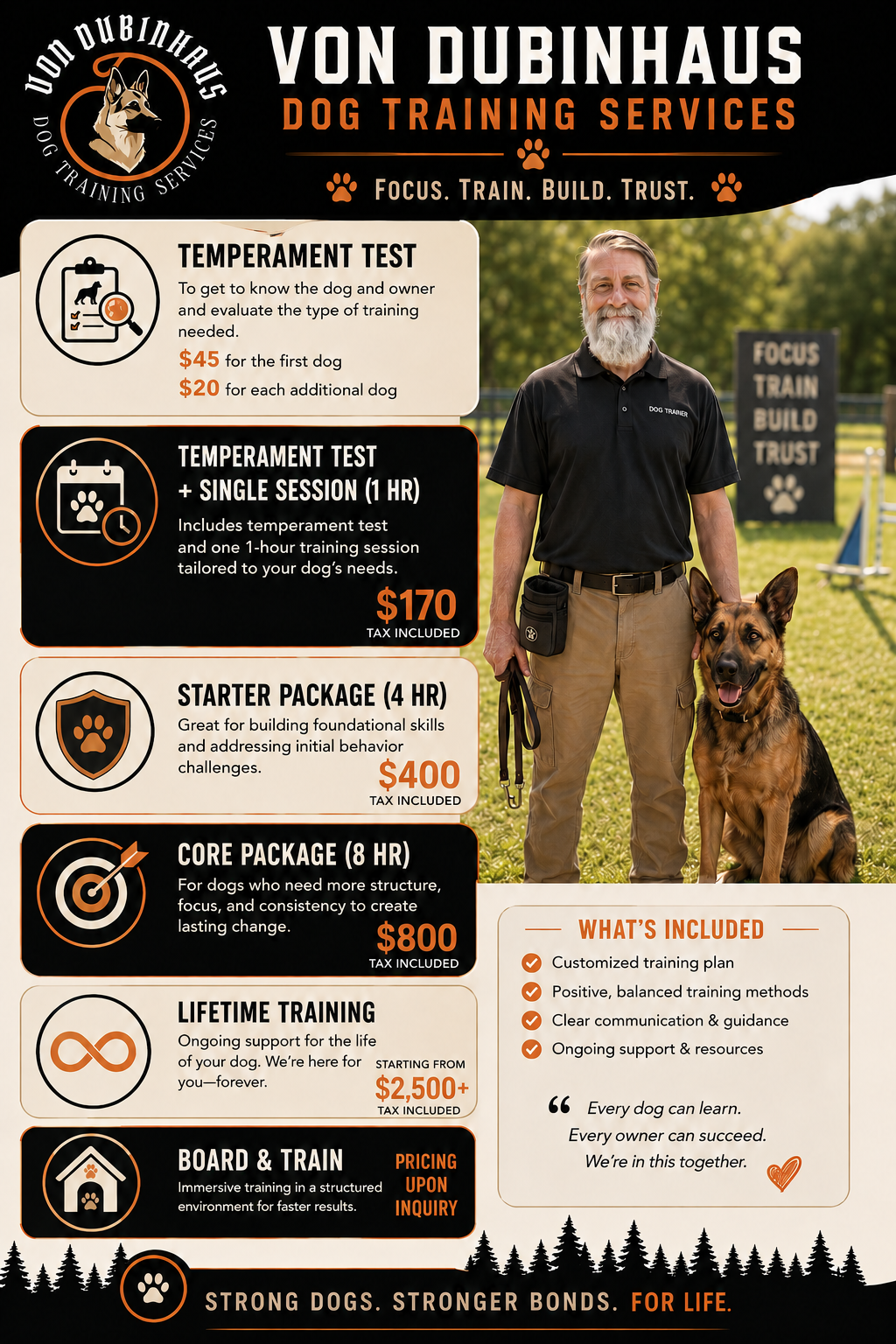
I offer several ways to work together, depending on where you are and what your dog needs:
Every new client starts with a Temperament Test ($45) —
45 minutes for me to meet your dog, assess where they are, and tell you exactly what I think they need. No pressure, no package upsell if it's not warranted. Just an honest read.
Initial Package — ($170) — Great if you want to identify the issue, get a plan, and run with it yourself. We’ll first do the temperament test then spend one focused hour with your dog and a clear roadmap before you leave.
Foundation Package — 4 Sessions ($400) — The right start for most dogs. We build the basics right, establish structure, and give you the tools to maintain it.
Transformation Package — 8 Sessions ($800) — For dogs with more complex issues: reactivity, aggression, anxiety, fear. This is where the real work happens. Eight sessions across a few months — summer to early fall is ideal timing.
Lifetime Training (from $2,500) — For owners who want unlimited support for the life of their dog. No expiration, no per-session fees. Just show up when you need us.
Board & Train — If you want immersive, intensive results while you travel or work, your dog stays with me. Minimum 4 weeks. Inquire for pricing and availability.
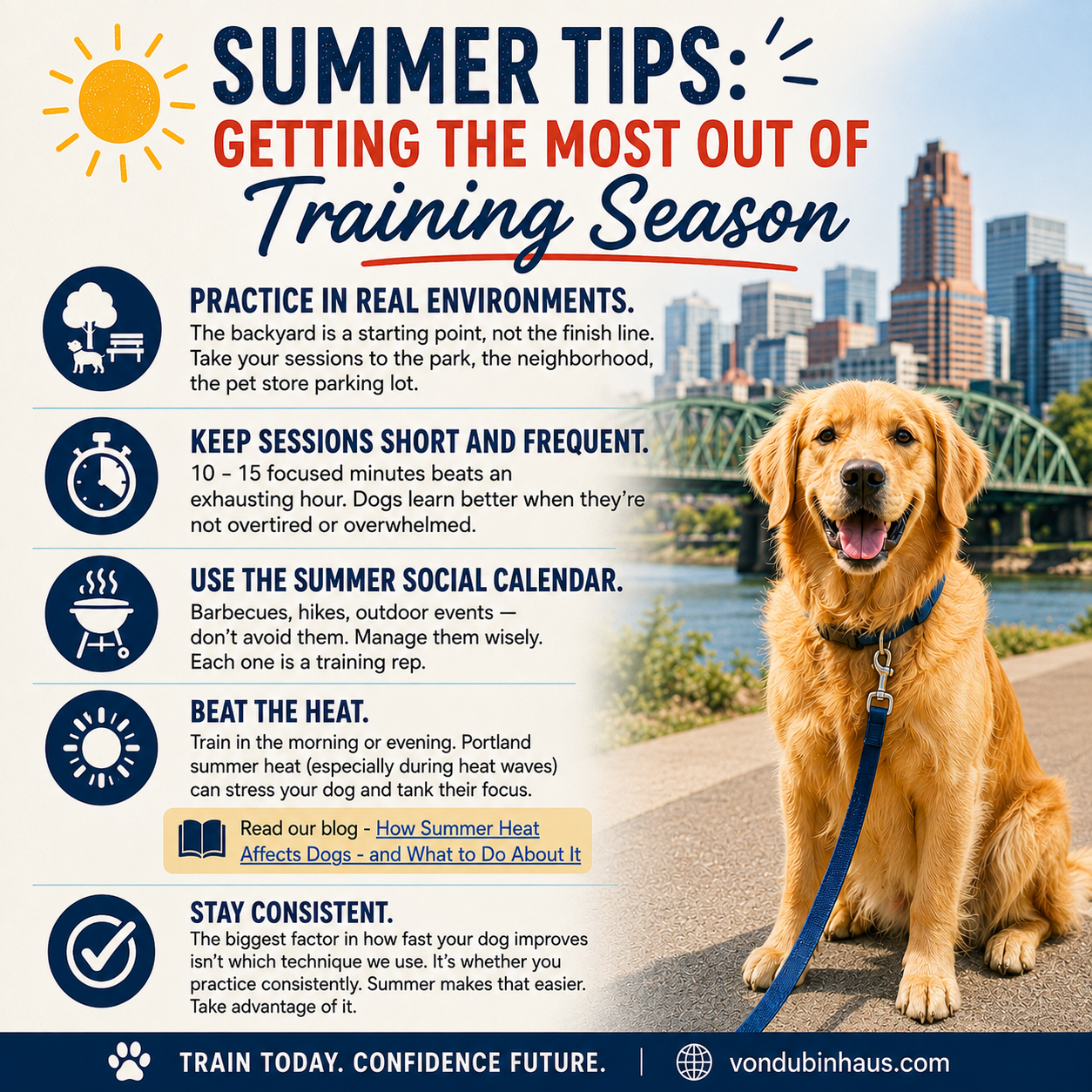
Summer Tips: Getting the Most Out of Training Season
If you're starting training this summer — with me or on your own — here's what I'd focus on:
FAQ: Summer Dog Training in Portland
Is it too hot to train my dog in summer?
Not if you time it right. Early morning (before 9am) or evening (after 7pm) are your windows on hot days. Avoid pavement during peak heat — it retains heat and can burn paws. Grass and shaded trails are always better choices in summer.
How many sessions will my dog need?
It depends on what we're working on. A dog with basic manners issues might turn a corner in 4 sessions. A dog with aggression, severe reactivity, or anxiety typically needs 8+ sessions and consistent owner follow-through between appointments. We'll map this out clearly after the temperament test.
Can I train an older dog in the summer?
Absolutely. Older dogs can absolutely learn — sometimes they're calmer and more focused than young dogs. The main adjustment is managing heat sensitivity, since older dogs can overheat more easily. We work around that.
What if my schedule is unpredictable in the summer?
That's fine. Sessions can be spaced out — weekly, biweekly, or whenever your schedule allows. The Foundation and Transformation packages don't expire, so you can work at your own pace.
Do you train dogs of all breeds?
Yes. I've worked with hundreds of breeds over 25 years — from small breeds to large working dogs. German Shepherds in particular are close to my heart (I bred from German working and show lines for years), but I don't turn any breed away.
How do I get started?
Call or text (503) 936-0641, or reach out through vondubinhaus.com. Every new client starts with a temperament test — $45 for your first dog, $20 for each additional dog. We'll take it from there.
Don't Let Summer Slip By
The window is open. The weather is cooperating. Your dog is active, engaged, and ready — whether you realize it or not.
Don't wait until September when the routine shifts again and the rain comes back and you're starting over. Summer is your moment. Use it.
Von Dubinhaus Dog Training Services
📍 14200 SE Woodward St, Portland, OR 97236
📞 (503) 936-0641
🌐 vondubinhaus.com
Book a temperament test — $45 for new clients.