
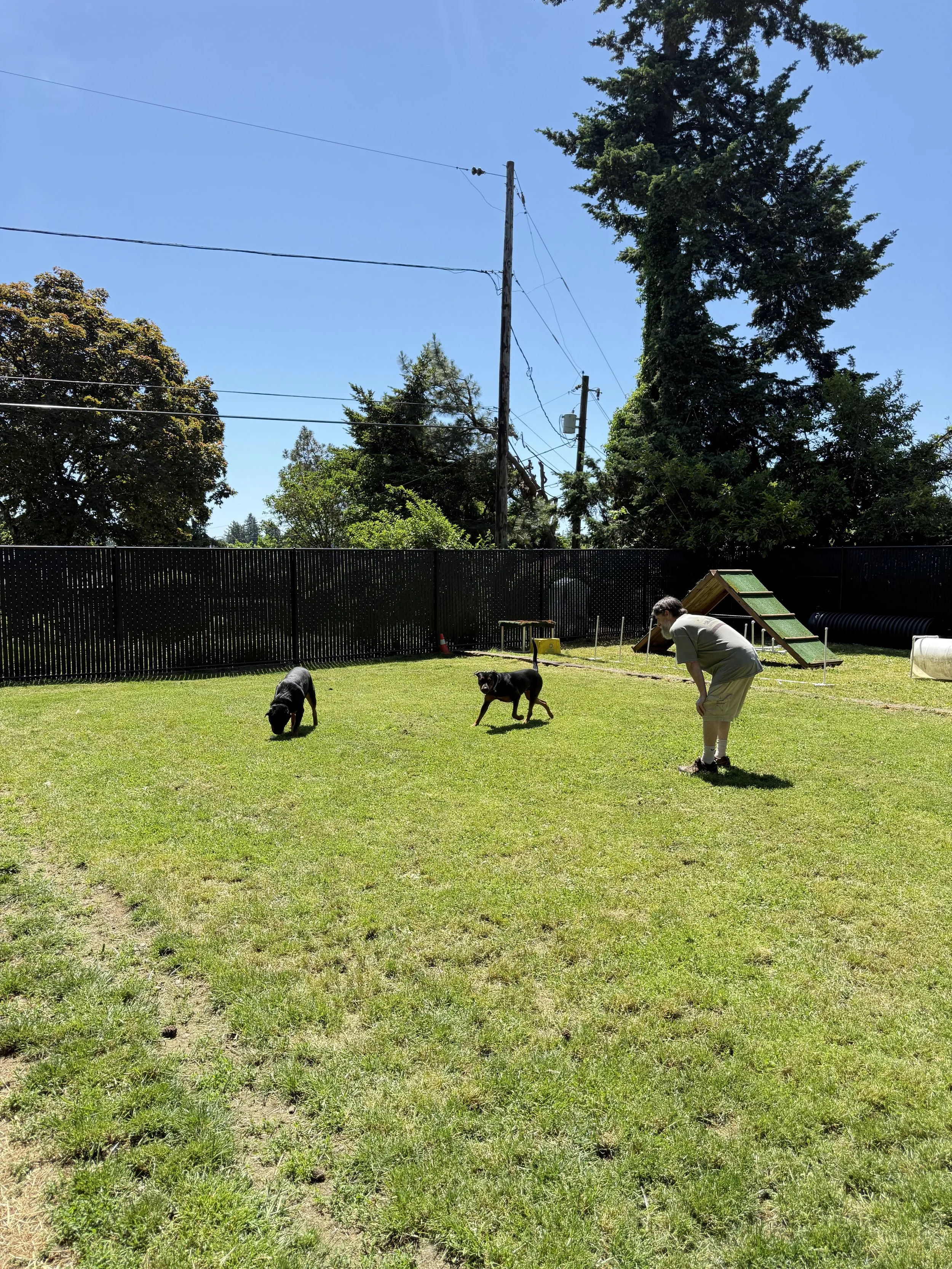
Inside the Von Dubinhaus Temperament Test: What I'm Actually Looking For
Every dog that comes through my door starts the same way.
Before we talk packages. Before I give you a single piece of advice. Before anything else — we do a temperament test. It's not a formality. It's not a box I'm checking. It's the most important 45 minutes we'll spend together, because everything that comes after depends on what I learn in those three parts.
This month, I'm waiving the temperament test fee entirely when you sign up for a Core Package or Lifetime Training at the same time. I'll tell you more about that at the end. First, let me show you exactly what this test is — because I think once you understand what I'm actually reading, you'll understand why it matters so much.
It's Not About Pass/Fail
The first important thing to note: the temperament test is not about whether your dog is "good" or "bad." I'm not going to tell you your dog failed. That's not what this is.
What I'm doing is reading your dog as an individual — how they process new environments, how they respond to pressure, how they handle uncertainty, how they relate to other dogs. Every dog has a temperament. I'm not judging it. I'm understanding it.
That understanding is what lets me build a training plan that actually works for your dog, not a generic template I hand to everyone who walks in.
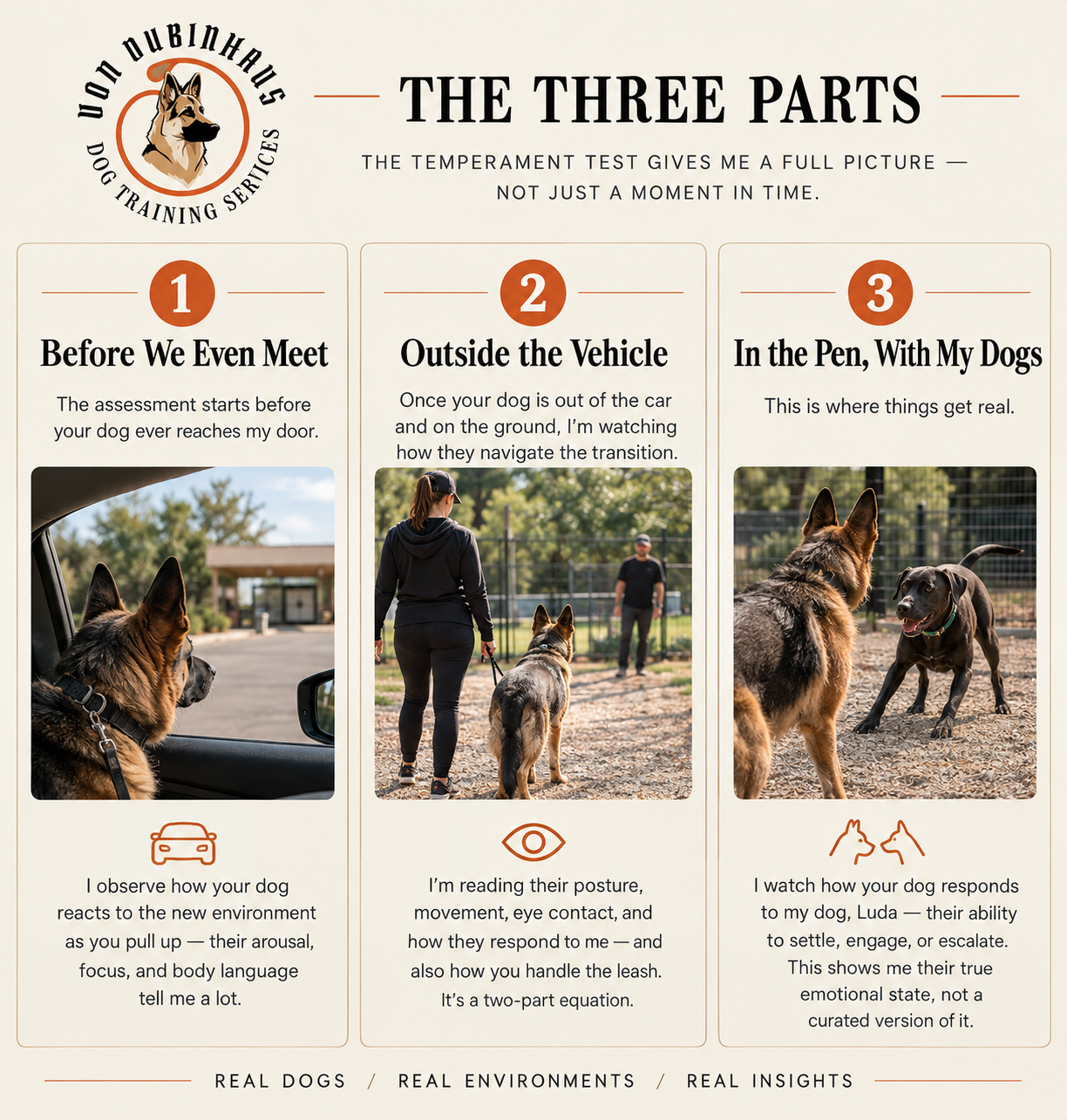
Part 1: Before We Even Meet
The assessment starts before your dog ever reaches my door.
When you pull up in your car, I'm watching. A dog who becomes highly agitated as the vehicle enters a new territory — who's escalating before you've even opened the door, fixating on the environment, scanning for threats — is telling me something. That level of territorial drive or environmental sensitivity is information. It tells me something about the dog's baseline arousal and how they experience new places.
Some dogs are loose and curious as you pull up. Some are alert but manageable. Some are already revved well past a calm baseline before we've said hello. All of that is data.
Part 2: Outside the Vehicle
Once your dog is out of the car and on the ground, I'm watching how they navigate the transition.
This is a dog in a genuinely new environment — new smells, new sounds, new person in front of them. What do they do? Do they move toward me with curiosity or hang back with uncertainty? Do they scan constantly, or can they settle into the moment? How do they handle the low-level unpredictability of a new space?
I'm reading posture, movement, eye contact patterns, how they respond when I introduce myself. A dog who's shut down is different from a dog who's reactive — and both are different from a dog who's loose and engaged. Each picture points me in a different direction when it comes to approach.
I'm also watching you in this moment. How you handle the leash, how your dog reads your energy, whether there's a communication gap between the two of you — that matters too. Training is always a two-part equation.
Part 3: In the Pen, With My Dogs
This is where things get real.
Once we're inside, I bring out my own dogs — my girl Luda is part of this process. I want to see how your dog responds to another dog in a controlled, structured environment.
What I'm looking for: Does your dog fixate hard, or can they settle? Do they escalate when the other dog approaches? Do they engage appropriately, or does the arousal spike in a way that suggests the underlying emotional state is something we need to work with? Can you redirect your dog's attention, or have they completely checked out of their relationship with you?
Luda is calm. He's experienced. He's not going to provoke anything unnecessarily. Which means if your dog reacts, I can be confident I'm seeing something genuine — not a response to another dog's provocative behavior.
This third piece is often the most revealing, especially for owners who've told me their dog is "fine with dogs it knows." The temperament test gives me a read on what's actually happening, not a curated version of it.
One Thing I Tell Almost Every Owner Before They Come In
Most dogs perform better than their owners’ expectations.
I mean that literally. The dog you've been managing, apologizing for, stressed about — that dog shows up and surprises you. They hold it together better than they do at home. They take in the new environment without completely losing their mind. They respond to me in ways that catch you off guard.
This happens more often than not, and I think it's worth saying out loud, because a lot of people show up to the temperament test braced for embarrassment. They've been living with the worst moments — the lunge at the neighbor's dog, the incident at the park, the thing that happened that they're not sure they should even mention. They assume that's what I'm going to see.
Sometimes I do. But often, what I see is a dog who was struggling in an environment without enough structure, without clear communication, without someone who knew how to read them — and who, given even a small amount of that, steps up.
That doesn't mean the work is easy. It doesn't mean the problems aren't real. But it does mean that the picture you've built of your dog in your head — often at their absolute worst — usually isn't the full picture. The temperament test is often the first time an owner sees their dog through a different lens.
Come in with whatever you've got. That's what I'm here for.
What You Leave With
After all three parts, we sit down and talk about the assessment. Plainly.
If the issue is behavioral — a training gap, a manners problem, a handler communication issue — I'll tell you that. If there's an emotional component driving what you're seeing — anxiety, fear, arousal, a history that left a mark — I'll tell you that too. And we’ll discuss what I think it will take to address it, including an honest estimate of timeline and effort.
I've done this long enough that I can tell within the first session whether a dog is going to turn around fast, take sustained work, or present a longer-term management challenge alongside training. I'd rather give you the real picture than a hopeful story that doesn't hold up.
Some of the most dramatic turnarounds I've seen came from dogs who looked like lost causes in Part 1 of their temperament test. Some of the easier-seeming dogs turned out to have layers that took longer to work through. The test tells me where we're actually starting — not where I hope we might be.
October Promo: Test Fee Waived
This month only, I'm waiving the $45 temperament test fee when you sign up for a training program at the same time.
Here's what that looks like:
Core Package — Eight one-hour sessions at $800. Start here if your dog has real behavioral issues we need to work through: reactivity, aggression, anxiety, leash problems that haven't responded to anything else. Eight sessions gives us the runway to do real, lasting work.
Lifetime Training — $2,500. Flat. No exceptions. This is the option for owners who want unlimited sessions for the life of their dog — regardless of how challenging the dog is. I don't charge more because a dog is harder. The $2,500 covers everything. Come as many times as you need for as long as you own that dog. For complex cases, it's often the most cost-effective path by a wide margin.
When you sign up for either program this October, the $45 temperament test fee is waived. The test still happens — It’s not skipped. It’s included within the training program. If you decide to sign up for the Lifetime Training after eight sessions, the $800 is deducted from the Lifetime Training price.
To schedule, call or text (503) 936-0641 or reach out through vondubinhaus.com/contact.
A Word on the Why
I've seen the alternative. Trainers who book a first session without ever really reading the dog. Generic programs built on assumptions that may or may not match your animal. Advice given confidently before anyone really understands what's driving the behavior.
I don't work that way, and I can't work that way.
Every dog I've trained across 25 years has been an individual. The plan that worked brilliantly for a German Shepherd with territorial reactivity was the wrong plan for an anxious rescue with a bite history even if the behaviors looked similar from the outside. The diagnosis has to come first.
The temperament test is how I do my job right.
FAQ: The Von Dubinhaus Temperament Test
What does a temperament test actually tell you?
It gives me a read on your dog's baseline reactivity level, environmental sensitivity, how they respond to unfamiliar people and other dogs, and how effectively you and your dog communicate with each other. That picture is the foundation for everything we do after.
Is the temperament test just an observation, or do you work with my dog?
Both. I observe first — how your dog arrives, how they move through a new environment. Then I work with your dog directly to feel how they learn and respond to structure. That hands-on read is part of what I'm assessing.
What if my dog reacts badly during the test?
That’s good. I want to see the real dog. A dog who's on their best behavior in a new place sometimes masks exactly what we need to understand. Reactivity, anxiety, over-arousal during the test — that's information, and it's useful.
Do you work with dogs who have a bite history?
Yes. Bite history doesn't automatically end the conversation — it adds context. Understanding why the bite happened is the starting point. Come in and let me assess.
What's included in the October promo?
The $45 temperament test fee is waived when you sign up for the Core Package (8 sessions, $800) or Lifetime Training ($2,500 flat) in October. The temperament test still happens — it's just included at no additional cost when you commit to a training program at the same time.
What makes Lifetime Training worth it?
No per-session fees. No expiration. No premium pricing for challenging dogs — the $2,500 rate is the same regardless of how hard or easy your dog is to work with. For any dog that's going to need ongoing work, or any owner who wants open access to come back whenever something new comes up, it's often the best value long-term.

Why Your Dog Pulls on the Leash — and How to Actually Fix It
If you've ever come home from a walk with a sore shoulder, a tangled leash, and a dog who looks like they ran a victory lap while you just survived a rodeo — you're not alone.
Leash pulling is the number one thing I hear about from new clients in Portland. And it makes sense: it's one of the most visible, daily reminders that something isn't working between you and your dog. Every walk is a negotiation you feel like you're losing.
Here's what I want you to understand: your dog isn't pulling because they're stubborn, dominant, or trying to disrespect you. They're pulling because it works. And until that changes, the pulling won't.
Why Dogs Pull — The Real Reason
Dogs pull on the leash for one simple reason: forward movement is the reward.
They want to get to the smell. They want to reach the other dog. They want to get around the corner faster. And every time they lean into the leash and you follow — which you do, because you're walking — they learn that pulling gets them where they want to go.
This isn't a character flaw. It's operant conditioning. The dog is doing exactly what makes sense given what they've learned.
The problem is that most of the "fixes" people try don't actually address this. They manage the pulling — or they suppress it temporarily — without changing the underlying understanding the dog has about how leash pressure works.
Why Most Fixes Don't Work
Let me go through the most common ones.
The stop-and-wait method. You stop every time the leash goes tight. The dog eventually comes back to you, you walk again, they pull, you stop. This can work for some dogs in low-distraction environments. But for a dog who's highly motivated — a dog who wants that smell or that dog down the street badly enough — stopping and waiting just means they're pausing between pulls. The pulling itself never gets addressed.
Front-clip harnesses. These are a management tool, not a training tool. A front-clip harness changes the physics of pulling — it redirects the dog rather than letting them get traction — but it doesn't teach the dog anything about where they should be. Take it off, put on a flat collar, and you're usually right back to square one.
Retractable leashes. I'll be blunt: retractable leashes actively teach dogs to pull. The mechanism rewards pressure on the leash with more leash. You are literally training your dog to pull every time you use one.
Treats and luring. Luring a dog into position with a treat in your hand can teach them the mechanics of walking near you — but it doesn't transfer well to real-world environments. The moment something more interesting than the treat appears (another dog, a squirrel, a kid on a bike), the behavior falls apart. Loose leash walking built on luring alone is leash walking that only works when nothing interesting is happening.
What Actually Works
Loose leash walking is a communication problem. Your dog doesn't understand that leash pressure means stop and check in with me — they've learned it means keep moving. The fix is teaching them a different response to the leash, and then building that response until it holds up in the real world.
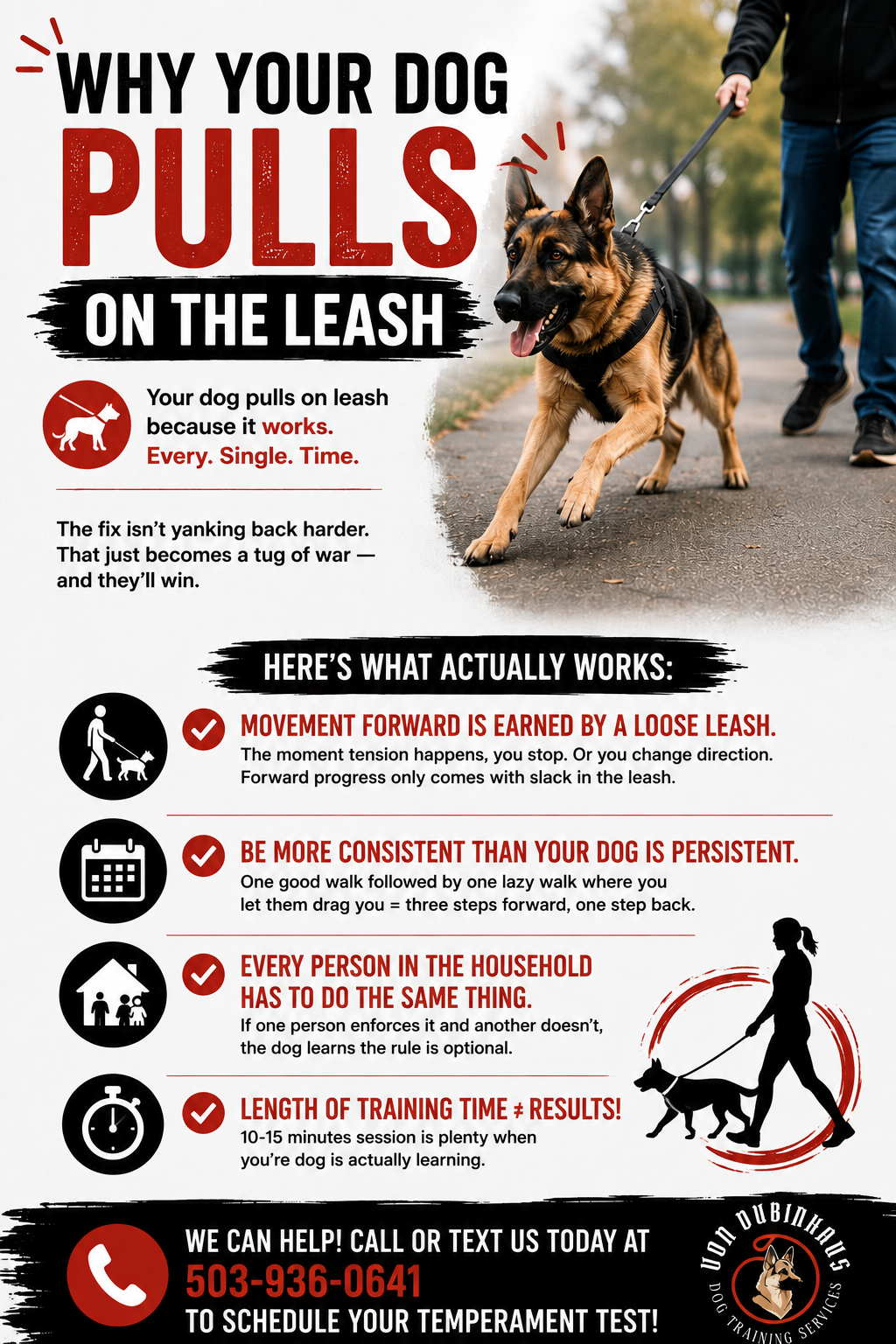
🦮 Movement Forward Is Earned by a Loose Leash
The moment tension happens, you stop. Or you change direction. Forward progress only happens with slack in the leash.
This retrains the fundamental equation your dog has learned. Right now they believe pulling = forward movement. You're teaching them the opposite: a tight leash stops progress, a loose leash creates it. Every single rep reinforces one version or the other — which is why consistency matters so much.
💪 Be More Consistent Than Your Dog Is Persistent
One good walk followed by one lazy walk where you let them drag you = three steps forward, one step back.
Dogs learn through repetition and pattern. If the rule is "pulling works sometimes," they will pull every time and wait to see if this is one of the times it works. The rule has to be the same on every walk, with every person, in every environment. That's what makes it real.
🧑🧑🧒🧒 Every Person in the Household Has to Do the Same Thing
If one person enforces it and another doesn't, the dog learns the rule is optional.
This is one of the most common reasons leash training stalls — the dog has figured out that the rules depend on who's holding the leash. Kids, partners, dog walkers, whoever takes them out: everyone needs to be working the same way. One exception unravels a lot of progress.
⏱️ Length of Training Time ≠ Results
A 10–15 minute session where your dog is actually learning beats an exhausting hour where you've both checked out. Keep it short, keep it focused.
Dogs learn best when they're engaged and not overtired. Long sessions lead to frustration for both of you and sloppy reps that reinforce the wrong things. End on a win, not on exhaustion. Short and frequent beats long and occasional every time.
🛑 Add Consequences, Not Just Rewards
This is where I'll probably say something some people don't want to hear: for a lot of dogs, rewards alone aren't enough to break a deeply ingrained pulling habit, especially in high-distraction environments.
If a dog has been pulling on leash for two years and the smell of that fire hydrant is the most compelling thing in their world, a treat in your hand is not going to outcompete it. You need to also communicate clearly that pulling is not the path forward — a leash correction, delivered calmly and at the right moment, does that. Not harsh, not angry. Clear.
Balanced training is not about punishing dogs. It's about giving them complete information: here's what gets you where you want to go, and here's what doesn't. Dogs who understand both sides of that equation learn faster and retain it better.
Interested in working on leash manners with Paul?
What Loose Leash Walking Actually Looks Like
I want to set realistic expectations here, because "loose leash walking" means different things to different people.
A loose leash doesn't mean your dog walks in a perfect heel with eyes locked on you the whole time. That's competition obedience — not what most owners need for daily life.
A loose leash means:
The leash has slack in it most of the time
Your dog checks in with you regularly instead of constantly straining forward
When something exciting appears, your dog notices it — but then comes back to you rather than launching themselves at it
You can redirect your dog's attention when you need to
That's achievable for almost every dog. But it takes real training, not just equipment changes.
Portland-Specific Notes
A few things that make leash manners especially important in Portland:
🪵 The trail system. Powell Butte, Springwater Corridor, Forest Park — these are beautiful, and they're full of other dogs, bikes, joggers, and wildlife. A dog who can't hold it together on leash is a dog you can't take to the places that make living in the Pacific Northwest so great.
🐾 Tight sidewalks. Portland neighborhoods have narrow sidewalks, and in summer they're busy. A dog who pulls you into every passer-by or lunges at every dog coming the other direction makes city walking miserable.
🏞️ Off-leash areas. Here's something people don't always connect: a dog with poor leash manners usually has a recall problem too. The same communication breakdown that causes pulling — the dog has learned that their agenda takes priority over yours — shows up in both behaviors. Fixing one often helps the other.
When to Call a Trainer
If you've been working on leash pulling for more than a few weeks without real progress, or if the pulling is combined with reactivity — your dog is also lunging, barking, or fixating on other dogs or people — it's time to get a professional read on what's happening.
Leash pulling combined with reactivity is a different problem than simple pulling. The emotional state driving it is different, and the approach needs to account for that. Treating it like a manners issue when it's actually an anxiety or arousal issue is one of the most common reasons training stalls.
A temperament test at Von Dubinhaus is $45 and takes about 45 minutes. You'll leave with an honest assessment of where your dog is and what it will actually take to get them where you want them to be.
A Quick Drill to Try This Week
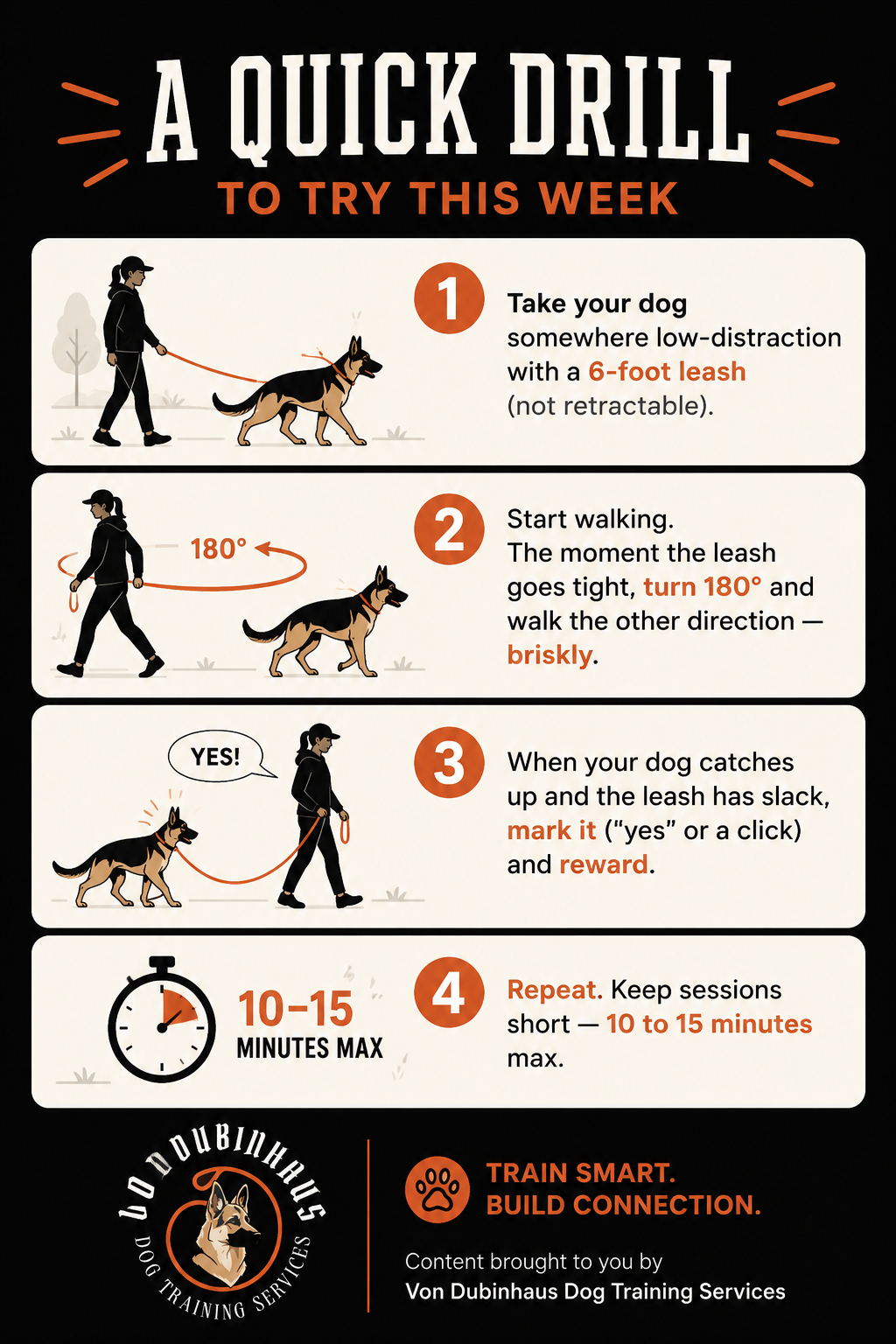
If you want to start working on this before you book anything, here's a simple drill:
Take your dog somewhere low-distraction with a 6-foot leash (not retractable).
Start walking. The moment the leash goes tight, turn 180° and walk the other direction — briskly.
When your dog catches up and the leash has slack, mark it ("yes" or a click) and reward.
Repeat. Keep sessions short — 10 to 15 minutes max.
You're teaching your dog two things: leash pressure means come back toward me, and staying near you is worth their while. That's the foundation.
It won't fix a year of pulling in one session. But done consistently, you'll start to see a different dog on the other end of that leash.
FAQ: Leash Pulling in Portland
What's the best tool to stop my dog from pulling?
There's no single tool that fixes pulling — it's a training problem, not an equipment problem. A prong collar, slip lead, front-clip harness, or flat collar can all be used effectively or ineffectively depending on how they're applied. The tool matters less than the training behind it.
My dog only pulls toward other dogs. Is that still a leash pulling problem?
It can be — but it might also be reactivity or over-arousal around other dogs, which is a different issue. If your dog is pulling and also vocalizing, lunging, or losing their ability to focus on anything else, that's worth a professional assessment.
How long does it take to train loose leash walking?
For a dog without reactivity, most owners see meaningful improvement in 2–4 sessions with consistent practice in between. For dogs who've been pulling for years or who have reactivity layered in, it takes longer. The good news: it's one of the most solvable problems in dog training.
My dog walks fine on a harness but pulls on a flat collar. Which should I use?
Use whichever allows you to communicate most clearly and safely — but don't mistake "the harness stops the pulling" for "my dog learned not to pull." If you want the behavior to transfer across equipment and environments, that requires actual training, not just switching tools.
Can I fix leash pulling without treats?
Yes. Treats are useful but not required. What's required is clear communication — the dog needs to understand what you want, and there need to be consequences (positive and corrective) that make your preferred behavior the obvious choice. Some dogs are barely food-motivated. We work with what each dog responds to.
Is leash pulling ever a sign of a bigger problem?
Sometimes. If pulling is accompanied by high arousal, fixation on triggers, or an inability to settle on leash even in calm environments, there's usually more going on than manners. That's worth looking at more closely.

Peanut & Butter: A Year of Progress, Two Very Different Dogs
A note from Rachel, current client at Von Dubinhaus:
I’d like to share an honest story. Not a before-and-after with a tidy ending, but the real thing — because I think that's actually more useful.
Peanut and Butter are my two German Shepherd mixes. Both around 70 pounds. Both rescues. Both brought to Paul in July 2024 with a situation I'd been managing — barely — for too long.
Butter was the one with the history. She was bitten by another dog when she was a puppy, and I think it left a mark on her that never fully healed on its own. She came into adulthood reactive to other dogs — really reactive. Lunging, barking, fixating. And at her worst, she'd bitten a person. That's not something you say easily. But it's true, and it's part of why I needed more than management tips.
Peanut, sweet Peanut, had a different problem: she took all his emotional cues from Butter. Where Butter went, she went. When Butter escalated, she followed. On their own she was easier — together, they amplified each other into chaos.
I'd been doing my best, but we needed more help. So I called Paul.
What Paul Saw
From Paul
When Rachel brought Peanut and Butter in, I assessed them separately first — which is almost always the right call when you have two dogs who influence each other's emotional state. You need to understand who each dog actually is without the other one in the picture.
What I saw in Butter was a dog running an anxiety load she'd been carrying for a long time. The reactivity toward other dogs had roots — a bad early experience that never got properly processed. She'd built a defensive pattern around it: react first, ask questions never. And that pattern had become so automatic she probably didn't even know she had a choice.
The bite had happened out of that same place. Not predatory, not dominant — defensive. A dog who'd learned that offense was the only way she knew how to protect herself.
Peanut was a different case entirely. Calmer baseline, more naturally biddable, quicker to engage. Her reactivity was learned from proximity to Butter, not rooted in her own anxiety. Take away the trigger — Butter's escalation — and you had a dog who was genuinely easy to work with.
Same household. Same owner. Completely different work.
Training Them Separately: Why It Mattered
We didn't work Peanut and Butter together at first. That was intentional.
When one dog in a pair is driving the emotional temperature, training them together just means the calmer dog is constantly being pulled back toward the reactive one's ceiling. You never get to see what either dog is actually capable of on their own. And more importantly, you never get to build each dog's individual relationship with their owner — which is the real foundation of everything.
Rachel worked with them separately. Session by session, she was learning to read each dog individually, communicate more clearly, and hold structure in a way that meant something to each of them specifically.
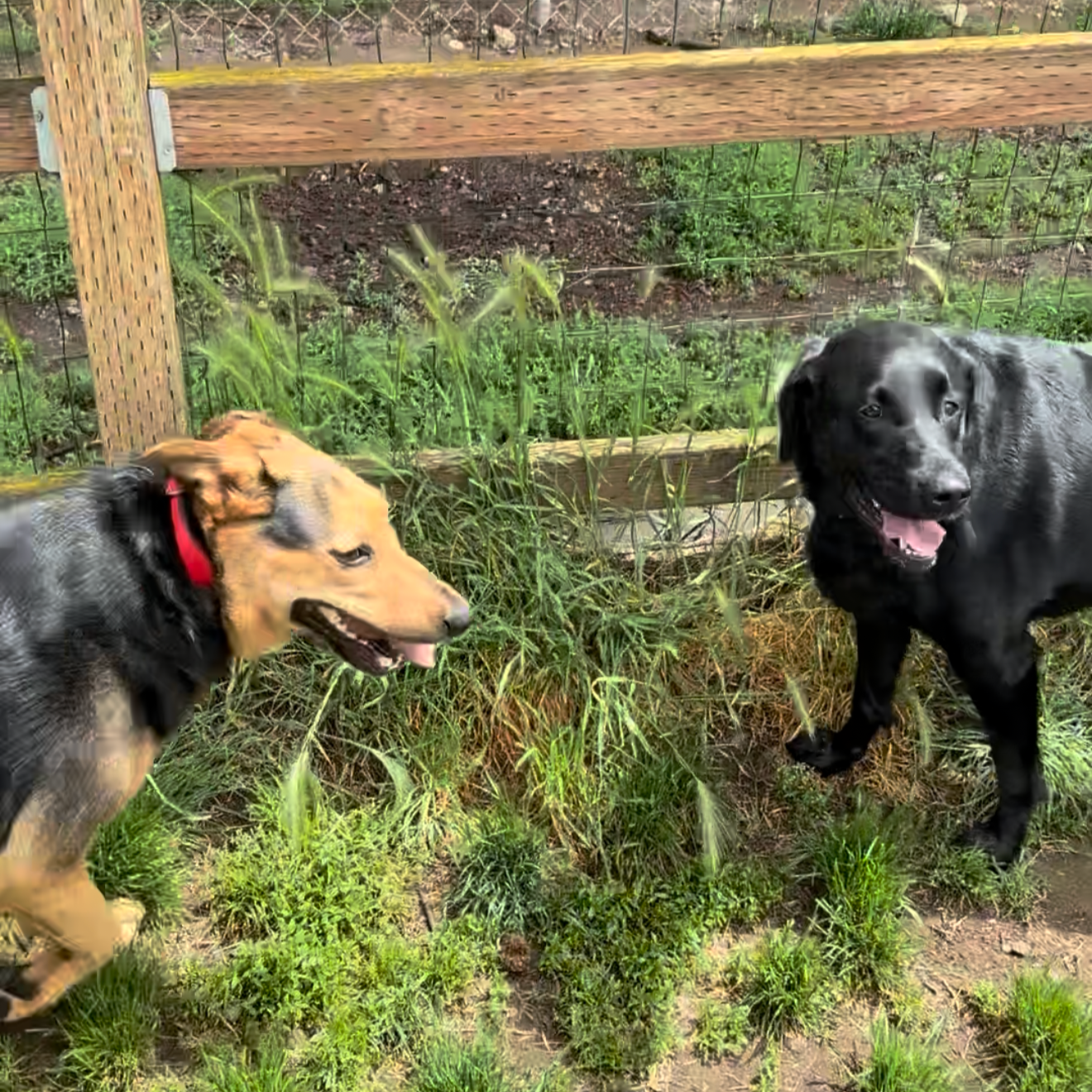
Peanut responded fast. Within the first handful of sessions, the picture shifted. The dog who'd been riding Butter's reactivity off a cliff started showing his actual personality — social, willing, curious. She didn't need much to become less reactive. She just needed Butter's influence out of the room and a clear set of expectations from Rachel.
The milestone that sticks with me: Peanut playing with Luda.
Luda is the resident assistant trainer dog, and he's part of how I work with some of the dogs I train. For Peanut to be comfortable enough — calm enough, trusting enough — to play with another dog in a new environment meant the foundation was genuinely there. That's not a trick. That's a different dog.
Butter's Journey — Still in Progress, and That's Okay
Butter's story is different. Longer. More layered. And I think it's worth telling honestly because I meet a lot of owners whose dogs resemble Butter’s challenges, and they need to hear this: progress isn't always linear, it doesn't always come fast, and "still working on it" doesn't mean failure.
Butter has made enormous strides. The change that surprises people most isn't the reactivity work — it's what happened with people. A dog who had bitten a person is now the dog that strangers call sweet. People meet her and fall in love with her. That's not an exaggeration. That's who she is now with humans.
That shift happened because when we reduced the anxiety load overall — when Butter started to feel safer in her own skin — the defensive behavior with people didn't have anything to stand on anymore. She didn't actually want to be scary. She just hadn't known how not to be.
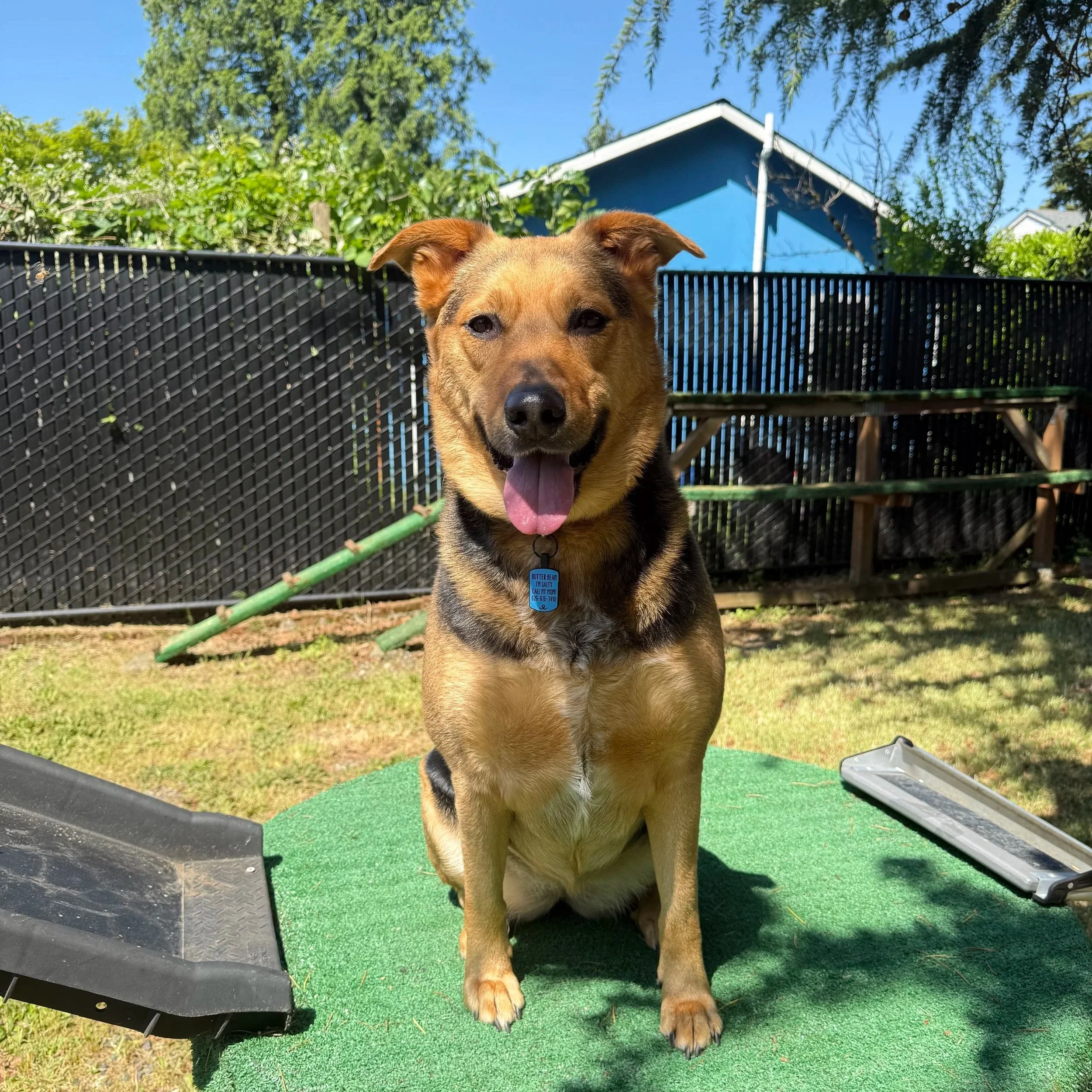
There's another moment Rachel mentioned that I think captures where Butter is now: her neighbor's dog was barking in the yard, and Butter looked to Rachel instead of exploding. She was still alert — she noticed, she felt it — but she waited. She checked in. She made a choice.
That's the work. Not the absence of feeling, but the presence of a different response.
Her dog reactivity is still being worked on. She's not where Peanut is. At my place, around my dogs, both Peanut and Butter are both calm and happy dogs — that's real and significant progress. But in the wider world, Butter still has triggers we're working through. We're over a year in, and we're still going. That's honest.
What I'd Tell Someone Who Has a Dog Like Butter
Back to Rachel:
When I started this journey in July 2024, I wasn't sure what to hope for. I'd told myself a version of "this is just who she is" or “this is our lives forver” so many times I'd almost believed it.
I don't believe that anymore.
What I know now is that progress looks different for different dogs. Peanut found her footing quickly. Butter is teaching me patience. Both of those are real, and both are worth something.
If you have a dog with a bite history — if you have a dog that people are afraid of, or that you're afraid to walk — I want you to hear this: that history doesn't have to be the end of the story. It doesn't mean your dog is broken. It means something happened, and your dog responded the only way they knew how.
Paul doesn't give up on dogs like Butter. And Butter doesn't give up on herself either, even when progress is slow.
Strangers and friends call her sweet now. That still gets me every time.
Is Your Dog Struggling with Reactivity or Fear?
If Butter's story sounds like your dog — reactive, fearful, maybe with a history you're not proud of — I'd encourage you to come in before you write any conclusions.
Every new client starts with a Temperament Test — $45 for your first dog, $20 for each additional. Paul will tell you honestly what he sees and what he thinks is possible. No hard sell. No false promises.
Some dogs turn around fast. Some take longer. Both are worth doing.
Von Dubinhaus Dog Training Services
📍 14200 SE Woodward St, Portland, OR 97236
📞 (503) 936-0641
🌐 vondubinhaus.com
FAQ: Reactive and Fearful Dogs in Portland
Can a dog with a bite history be rehabilitated?
In many cases, yes. Bite history doesn't automatically mean a dog is dangerous beyond help — it means something went wrong and the dog learned a response that worked for them. Understanding why the bite happened is the starting point. From there, we assess what's possible and what the realistic path looks like. Butter is a living example.
How long does reactive dog training take?
It depends on the dog and the root cause. Some dogs turn the corner in a handful of sessions. Others — especially dogs with anxiety-rooted reactivity or trauma history — take longer. A year-plus timeline for a complex case isn't failure; it's honest work. We don't put a deadline on the dog.
My dog is reactive to other dogs but fine with people. Is that a specific issue?
Yes, and it's very common. Dog-to-dog reactivity and human reactivity often have different roots and respond differently to training. A dog who's one and not the other — like Butter — gets a plan built around that specific dynamic.
Can two reactive dogs from the same household be trained?
Yes, but they're usually best worked with separately at first, especially when one is influencing the other's behavior. Once each dog has their own foundation, joint work becomes more productive.
What if I've tried other trainers and my dog hasn't improved?
Come in anyway. The approach matters enormously. If previous training didn't address the emotional root of the behavior, it's not surprising that the behavior persisted. A fresh read from an experienced eye can change the picture.
Do you work with dogs who have bitten people?
Yes. It's part of the work I do — and in my experience, dogs who have bitten out of fear or anxiety are often the most workable cases once the underlying cause is understood and addressed.

Why Summer Is the Best Time to Train Your Dog in Portland
Most people assume summer is a bad time for dog training. Life gets busy. The kids are home. There are trips, barbecues, hiking plans, and about a hundred other things pulling at your attention. The dog's training can wait until fall, right?
Summer isn't just a fine time to train your dog. In my experience, it's the best time. And if you've been putting it off, you're sitting on one of the best windows you'll have all year.
Here's why.
Portland Summers Are a Training Dream
Let's start with the obvious: the weather ☀️
From July through September, Portland is stunning. Dry, warm, long days — the kind of conditions that make outdoor training genuinely enjoyable for both you and your dog. Compare that to seven months of gray drizzle, and you'll understand why I tell clients to take advantage of summer while it's here.
Dog training is most effective when it happens in real-world environments — parks, sidewalks, parking lots, trails. The outdoors is where the real work gets done, where distractions exist, where your dog actually learns to listen when it matters. And summer in Portland makes getting outside easy, consistent, and sustainable.
Rain is a barrier most people don't acknowledge. When it's cold and wet and getting dark at 4:30pm, outdoor practice sessions drop off fast. The homework doesn't get done. The skills don't stick. Summer removes that friction entirely.
More Time Together = Faster Progress
Here's something that doesn't get talked about enough in dog training: you are the variable that matters most.
I can work with a dog for an hour and make real progress. But if you're not reinforcing what we do between sessions — if you're not practicing, not holding the structure, not reading your dog — that progress fades. Dog training is a partnership. The owner is always part of the equation.
Summer changes that equation in your favor. Whether you're working from home more, taking time off, or just generally spending more hours outside with your dog, the summer months give you more face time with your animal. And more face time means more practice repetitions, more consistency, and faster results.
I've seen dogs who'd been struggling with the same issues for two or three years finally turn a corner over a single Portland summer — not because anything magic happened, but because their owners were finally home enough to do the work.
Summer Exposes Everything (Which Is Exactly What You Want)
One of the trickiest things about dog training is that a lot of dogs behave perfectly fine at home, in quiet environments, with no distractions. Put them on a crowded street, at a park with kids and bikes and other dogs, or in a busy parking lot, and suddenly everything you thought they knew evaporates.
Summer is full of those high-distraction moments. Farmers markets. Trails. Patios. Street fairs. Neighborhood kids on bikes. Other dogs everywhere.
For a dog with behavioral issues — reactivity, leash pulling, poor recall, anxiety around strangers — that can sound stressful. But here's the reframe: those moments are the classroom. That's where the real training happens. You can't fix a reactive dog by practicing only in your backyard. You have to get them into the environment that challenges them, with the right guidance, and teach them a different response.
Summer hands you an endless supply of training scenarios. That's not a problem — that's an opportunity.
The Best Dogs I've Ever Worked With Were Summer Dogs
I don't mean that literally. I mean the most dramatic turnarounds I've seen — the dogs that came in reactive, anxious, aggressive, or completely unmanageable and left as balanced, calm animals — a disproportionate number of those happened over summer training programs.
Part of it is the weather and the consistency I mentioned. But part of it is also this: summer has an end date. There's a natural built-in urgency. You want your dog trained before school starts again, before fall fills back up, before the routine shifts. That motivation is real, and it matters. Motivated owners get results.
If you've been waiting for the right time — this is it.
What Summer Training at Von Dubinhaus Looks Like
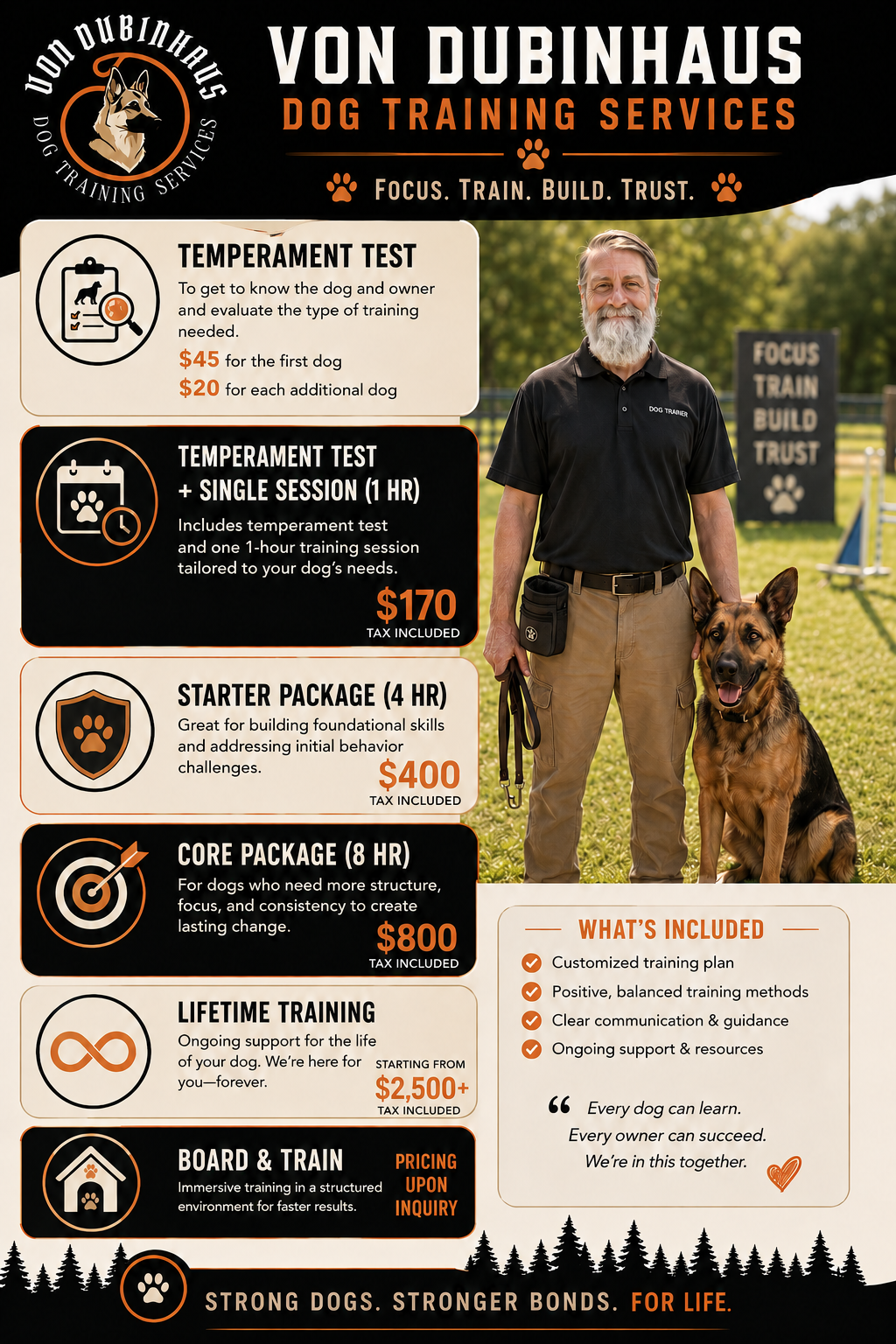
I offer several ways to work together, depending on where you are and what your dog needs:
Every new client starts with a Temperament Test ($45) —
45 minutes for me to meet your dog, assess where they are, and tell you exactly what I think they need. No pressure, no package upsell if it's not warranted. Just an honest read.
Initial Package — ($170) — Great if you want to identify the issue, get a plan, and run with it yourself. We’ll first do the temperament test then spend one focused hour with your dog and a clear roadmap before you leave.
Foundation Package — 4 Sessions ($400) — The right start for most dogs. We build the basics right, establish structure, and give you the tools to maintain it.
Transformation Package — 8 Sessions ($800) — For dogs with more complex issues: reactivity, aggression, anxiety, fear. This is where the real work happens. Eight sessions across a few months — summer to early fall is ideal timing.
Lifetime Training (from $2,500) — For owners who want unlimited support for the life of their dog. No expiration, no per-session fees. Just show up when you need us.
Board & Train — If you want immersive, intensive results while you travel or work, your dog stays with me. Minimum 4 weeks. Inquire for pricing and availability.
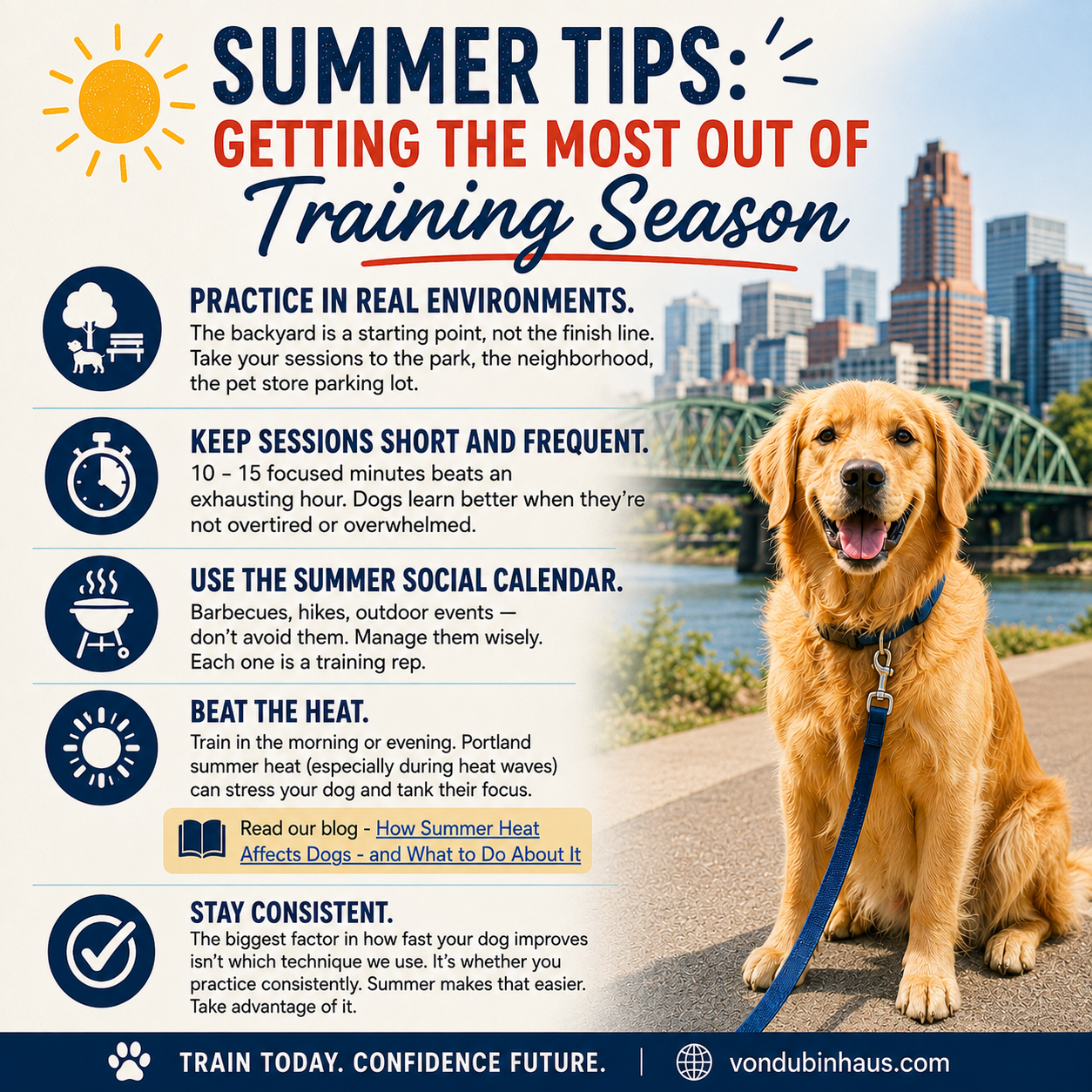
Summer Tips: Getting the Most Out of Training Season
If you're starting training this summer — with me or on your own — here's what I'd focus on:
FAQ: Summer Dog Training in Portland
Is it too hot to train my dog in summer?
Not if you time it right. Early morning (before 9am) or evening (after 7pm) are your windows on hot days. Avoid pavement during peak heat — it retains heat and can burn paws. Grass and shaded trails are always better choices in summer.
How many sessions will my dog need?
It depends on what we're working on. A dog with basic manners issues might turn a corner in 4 sessions. A dog with aggression, severe reactivity, or anxiety typically needs 8+ sessions and consistent owner follow-through between appointments. We'll map this out clearly after the temperament test.
Can I train an older dog in the summer?
Absolutely. Older dogs can absolutely learn — sometimes they're calmer and more focused than young dogs. The main adjustment is managing heat sensitivity, since older dogs can overheat more easily. We work around that.
What if my schedule is unpredictable in the summer?
That's fine. Sessions can be spaced out — weekly, biweekly, or whenever your schedule allows. The Foundation and Transformation packages don't expire, so you can work at your own pace.
Do you train dogs of all breeds?
Yes. I've worked with hundreds of breeds over 25 years — from small breeds to large working dogs. German Shepherds in particular are close to my heart (I bred from German working and show lines for years), but I don't turn any breed away.
How do I get started?
Call or text (503) 936-0641, or reach out through vondubinhaus.com. Every new client starts with a temperament test — $45 for your first dog, $20 for each additional dog. We'll take it from there.
Don't Let Summer Slip By
The window is open. The weather is cooperating. Your dog is active, engaged, and ready — whether you realize it or not.
Don't wait until September when the routine shifts again and the rain comes back and you're starting over. Summer is your moment. Use it.
Von Dubinhaus Dog Training Services
📍 14200 SE Woodward St, Portland, OR 97236
📞 (503) 936-0641
🌐 vondubinhaus.com
Book a temperament test — $45 for new clients.
Balanced Dog Training vs. Positive Only: What's the Difference?
If you've spent any time researching dog training, you've probably run into this debate. It shows up in Facebook groups, Reddit threads, and even between trainers at the park. Positive only vs. balanced training — two camps, strong opinions, and a lot of confusion for dog owners who just want to know what actually works.
After 25 years of training dogs in Portland — everything from family pets to severe aggression cases — I've watched this conversation evolve. And I think most dog owners deserve a straight, honest answer instead of marketing spin from either side.
So here's my personal take.
What Is Positive-Only Dog Training?
Positive-only training (also called force-free or R+ training) is built around one core principle: reward the behaviors you want, ignore or redirect the behaviors you don't. No corrections, no aversives, no physical or verbal pressure. The dog learns that good choices lead to good things — treats, praise, play — and is never punished for making a wrong one.
In the right hands, this approach works beautifully for a lot of dogs. Puppies, food-motivated dogs, dogs learning basic obedience, dogs with no major behavioral issues — positive-only can get excellent results. And it's genuinely kind. That matters.
The limitation? For some dogs, especially those dealing with aggression, reactivity, anxiety-driven behavior, or deeply ingrained habits, reward-only training isn't enough on its own. When a dog is in a heightened emotional state — threshold, triggered, over-aroused — they often can't access the food reward at all. The treat isn't the most important thing in the room anymore. And without any other tool in the toolbox, the trainer is stuck.
What Is Balanced Dog Training?
Balanced training uses the full picture of how dogs learn. In behavioral science terms, it works with all four quadrants of operant conditioning:
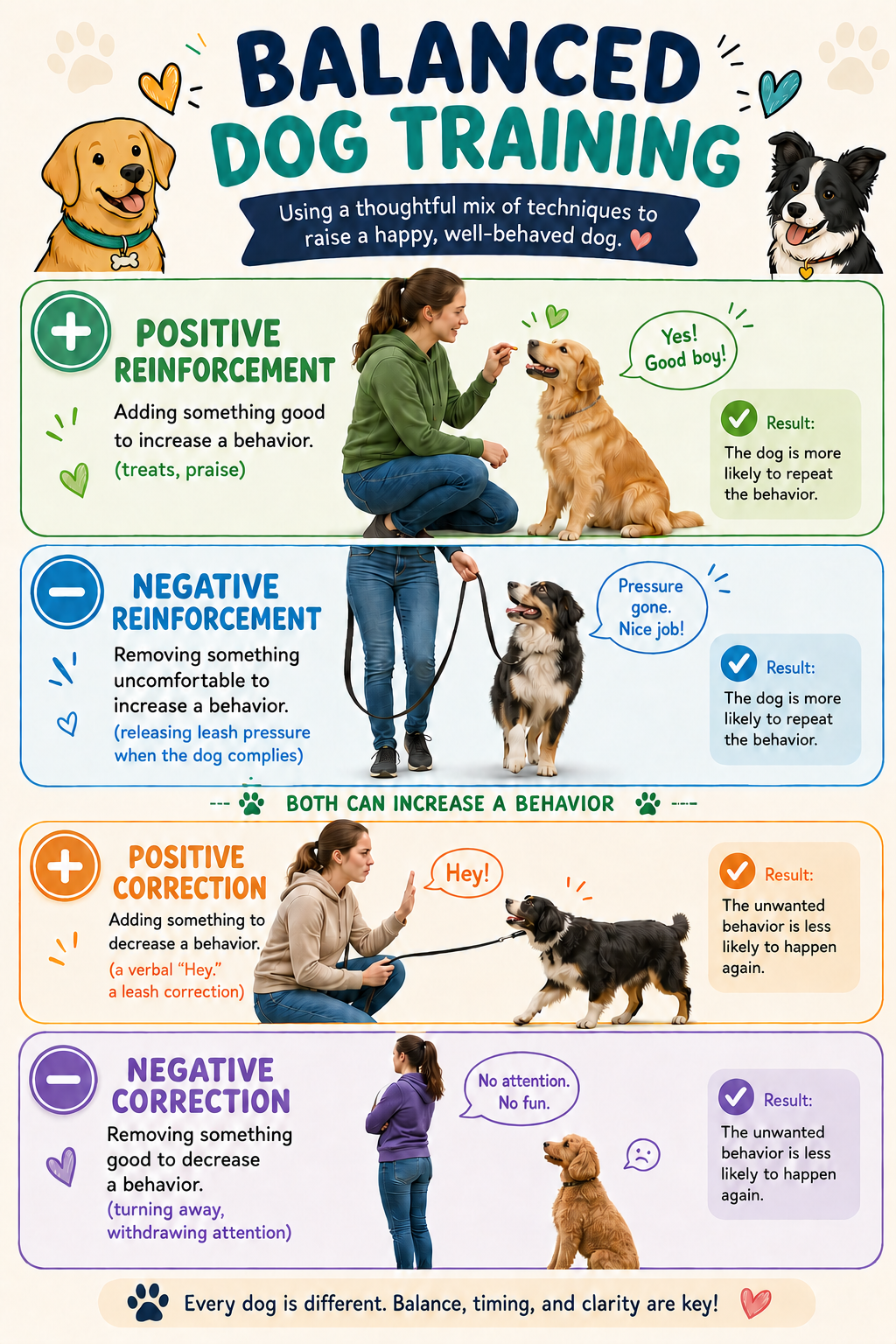
Balanced Dog Training
Positive reinforcement — adding something good to increase a behavior (treats, praise)
Negative reinforcement — removing something uncomfortable to increase a behavior (releasing leash pressure when the dog complies)
Positive correction — adding something to decrease a behavior (a verbal "hey," a leash correction)
Negative correction — removing something good to decrease a behavior (turning away, withdrawing attention)
Balanced doesn't mean harsh. It doesn't mean old-school dominance theory, shock collars on every dog, or punishing a dog for being a dog. Done well, it means reading each dog as an individual, using the least amount of pressure needed to communicate clearly, and pairing corrections with rewards so the dog understands both what you don't want and what you do.
The goal is always the same: a dog who's calm, clear, and confident — not one who's suppressed or afraid.
The Cases That Show You the Difference
Here's where I'll get specific, because I think examples matter more than theory.
I've worked with hundreds of dogs over the years — including 15 years running a rescue operation where I placed dogs in new homes. I've seen dogs come through my door that other trainers had already given up on. Dogs who'd bitten people. Dogs so anxiety-ridden they couldn't leave the house. Dogs that had been through months of positive-only training with no real progress.
The thing I see most often: a dog who's been rewarded into compliance in low-distraction environments, but falls completely apart the moment the stakes go up. The leash goes on, a dog appears across the street, and suddenly the training disappears. Why? Because no one ever taught the dog that they still had to make the right choice even when they didn't want to.
Balanced training gives you that. A correction — delivered calmly, clearly, and proportionally — communicates to the dog: that choice isn't available to you. Followed immediately by a reward when they make the right choice, the dog learns both edges of the boundary. That clarity is actually what creates a calm, stable dog.
I'm not anti-positive-only training. I use positive reinforcement constantly — it's the foundation of everything I do. But I won't pretend that rewards alone can rehabilitate a dog with severe aggression or deep-rooted reactivity. That's not honest, and dog owners deserve honesty.
Why This Debate Gets Heated (And What It Misses)
The online discourse around this topic often turns into an all-or-nothing fight. Positive-only trainers accuse balanced trainers of being cruel. Balanced trainers accuse positive-only trainers of being naive. Meanwhile, actual dog owners are stuck in the middle, not knowing who to trust.
Here's what I think the debate misses: it's not about the method, it's about the dog in front of you.
A skilled trainer — no matter what their philosophical leaning — is reading the individual dog, adjusting in real time, and asking: what does this dog need to understand what I'm asking? What's going to be clearest, kindest, and most effective for this animal, today, in this situation?
That's what 25 years of experience actually teaches you. Not allegiance to a camp. The ability to read a dog.
What This Means for Your Dog
If your dog is dealing with any of the following, it's worth having an honest conversation with a trainer who has experience beyond reward-based work:
Aggression — toward people, other dogs, or in resource-guarding situations
Reactivity — lunging, barking, or inability to focus around triggers
Anxiety-driven or obsessive behaviors — destructive chewing, separation anxiety, compulsive behaviors
No recall — a dog who ignores you when something more interesting is present
Prior training that "worked at home" but not in real life
These aren't dogs that failed positive training. These are dogs that need more nuance — more tools, more clear communication, more experience behind the leash.
That's the work I do. It's the work I've always done.
What to Ask Any Trainer Before You Hire Them
Regardless of method, here are the questions I'd ask:
What experience do you have with dogs like mine? A trainer who specializes in anxious puppies and a trainer who specializes in aggression rehab are not interchangeable.
Can you explain why you're using a particular tool or technique? Good trainers can answer this clearly. "Because it works" isn't an answer.
What does success look like at 4 weeks? At 8 weeks? You should have a roadmap, not a vague promise.
Will you teach me, not just train my dog? The best training in the world doesn't stick if the owner doesn't learn how to maintain it.
Have you worked with cases that looked like mine? Ask for specifics. Real experience shows.
FAQ: Balanced Training in Portland
Is balanced dog training safe?
Yes — when done by an experienced trainer who uses the minimum effective level of pressure for each dog. Balanced training in the wrong hands can cause problems, just like any other method. That's why experience and credentials matter.
Isn't positive-only training more humane?
Humane means what's genuinely in the dog's best interest — not what feels best to the human watching. Leaving a dog in a state of chronic anxiety, reactivity, or aggression because we won't use any correction is not humane. Clarity, structure, and appropriate consequences delivered calmly are not cruel.
My dog has been through positive-only training and still has issues. Now what?
This is one of the most common situations I see. It doesn't mean the previous trainer failed — it may just mean your dog needs more. Come in for a temperament test and let's see where we are. No judgment, just a fresh read on your dog.
Does balanced training use shock collars?
Not automatically, no. Balanced training is a philosophy, not a specific tool. Many balanced trainers, including myself, use prong collars, e-collars, slip leads, and flat collars depending on the dog, the behavior, and the situation. Every tool is introduced carefully and humanely.
How long does it take to see results with balanced training?
For most dogs, you'll notice real change within the first 2–4 sessions. Significant behavioral rehabilitation takes longer — typically 8+ sessions — and always involves teaching the owner alongside the dog.
Where can I get balanced dog training in Portland, OR?
Von Dubinhaus Dog Training Services has been Portland's go-to for balanced training since 1999. Call us at (503) 936-0641 or visit vondubinhaus.com to schedule your temperament test.
Ready to Get Real Results?
If you've been going in circles with your dog — or if you've been told there's nothing that can be done — I'd encourage you to come in before you give up. I've seen dogs turn around that I wouldn't have believed possible if I hadn't seen it myself.
That's not marketing. That's just 25 years of showing up.
Von Dubinhaus Dog Training Services
📍 14200 SE Woodward St, Portland, OR 97236
📞 (503) 936-0641
🌐 vondubinhaus.com
Start with a temperament test — $45 for new clients. $20 for each additional dog.