A note from Rachel, current client at Von Dubinhaus:
I’d like to share an honest story. Not a before-and-after with a tidy ending, but the real thing — because I think that's actually more useful.
Peanut and Butter are my two German Shepherd mixes. Both around 70 pounds. Both rescues. Both brought to Paul in July 2024 with a situation I'd been managing — barely — for too long.
Butter was the one with the history. She was bitten by another dog when she was a puppy, and I think it left a mark on her that never fully healed on its own. She came into adulthood reactive to other dogs — really reactive. Lunging, barking, fixating. And at her worst, she'd bitten a person. That's not something you say easily. But it's true, and it's part of why I needed more than management tips.
Peanut, sweet Peanut, had a different problem: she took all his emotional cues from Butter. Where Butter went, she went. When Butter escalated, she followed. On their own she was easier — together, they amplified each other into chaos.
I'd been doing my best, but we needed more help. So I called Paul.
What Paul Saw
From Paul
When Rachel brought Peanut and Butter in, I assessed them separately first — which is almost always the right call when you have two dogs who influence each other's emotional state. You need to understand who each dog actually is without the other one in the picture.
What I saw in Butter was a dog running an anxiety load she'd been carrying for a long time. The reactivity toward other dogs had roots — a bad early experience that never got properly processed. She'd built a defensive pattern around it: react first, ask questions never. And that pattern had become so automatic she probably didn't even know she had a choice.
The bite had happened out of that same place. Not predatory, not dominant — defensive. A dog who'd learned that offense was the only way she knew how to protect herself.
Peanut was a different case entirely. Calmer baseline, more naturally biddable, quicker to engage. Her reactivity was learned from proximity to Butter, not rooted in her own anxiety. Take away the trigger — Butter's escalation — and you had a dog who was genuinely easy to work with.
Same household. Same owner. Completely different work.
Training Them Separately: Why It Mattered
We didn't work Peanut and Butter together at first. That was intentional.
When one dog in a pair is driving the emotional temperature, training them together just means the calmer dog is constantly being pulled back toward the reactive one's ceiling. You never get to see what either dog is actually capable of on their own. And more importantly, you never get to build each dog's individual relationship with their owner — which is the real foundation of everything.
Rachel worked with them separately. Session by session, she was learning to read each dog individually, communicate more clearly, and hold structure in a way that meant something to each of them specifically.
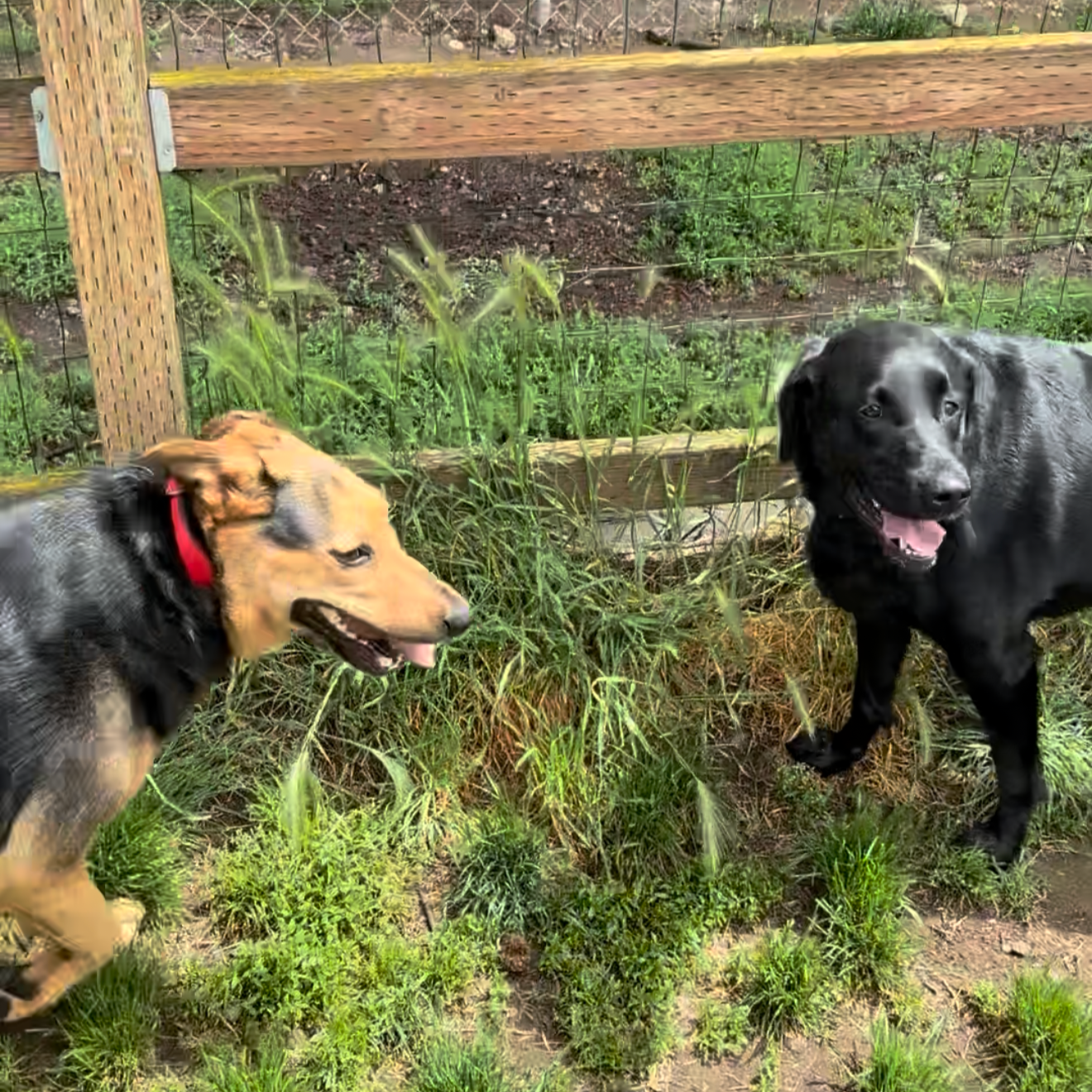
Peanut responded fast. Within the first handful of sessions, the picture shifted. The dog who'd been riding Butter's reactivity off a cliff started showing his actual personality — social, willing, curious. She didn't need much to become less reactive. She just needed Butter's influence out of the room and a clear set of expectations from Rachel.
The milestone that sticks with me: Peanut playing with Luda.
Luda is the resident assistant trainer dog, and he's part of how I work with some of the dogs I train. For Peanut to be comfortable enough — calm enough, trusting enough — to play with another dog in a new environment meant the foundation was genuinely there. That's not a trick. That's a different dog.
Butter's Journey — Still in Progress, and That's Okay
Butter's story is different. Longer. More layered. And I think it's worth telling honestly because I meet a lot of owners whose dogs resemble Butter’s challenges, and they need to hear this: progress isn't always linear, it doesn't always come fast, and "still working on it" doesn't mean failure.
Butter has made enormous strides. The change that surprises people most isn't the reactivity work — it's what happened with people. A dog who had bitten a person is now the dog that strangers call sweet. People meet her and fall in love with her. That's not an exaggeration. That's who she is now with humans.
That shift happened because when we reduced the anxiety load overall — when Butter started to feel safer in her own skin — the defensive behavior with people didn't have anything to stand on anymore. She didn't actually want to be scary. She just hadn't known how not to be.
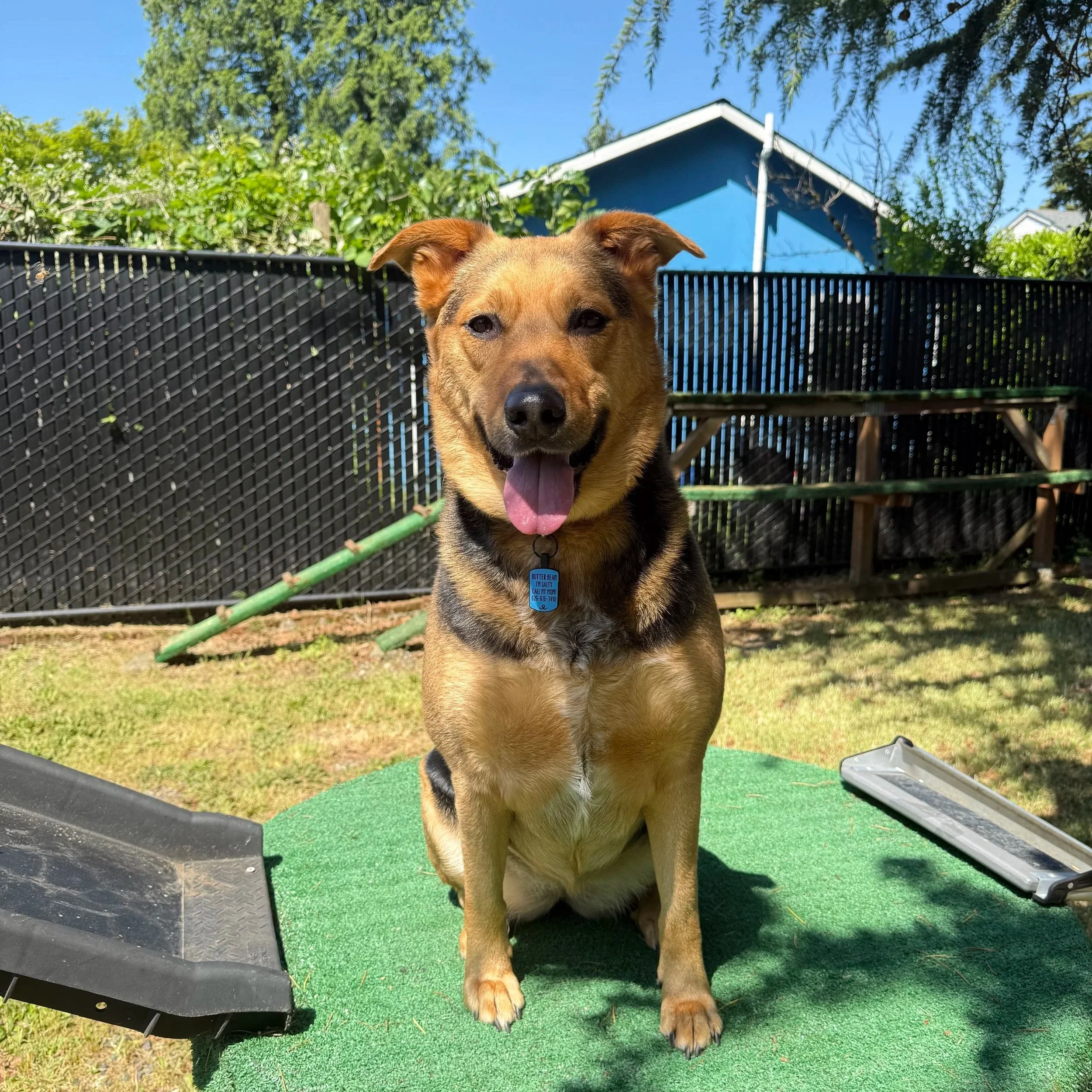
There's another moment Rachel mentioned that I think captures where Butter is now: her neighbor's dog was barking in the yard, and Butter looked to Rachel instead of exploding. She was still alert — she noticed, she felt it — but she waited. She checked in. She made a choice.
That's the work. Not the absence of feeling, but the presence of a different response.
Her dog reactivity is still being worked on. She's not where Peanut is. At my place, around my dogs, both Peanut and Butter are both calm and happy dogs — that's real and significant progress. But in the wider world, Butter still has triggers we're working through. We're over a year in, and we're still going. That's honest.
What I'd Tell Someone Who Has a Dog Like Butter
Back to Rachel:
When I started this journey in July 2024, I wasn't sure what to hope for. I'd told myself a version of "this is just who she is" or “this is our lives forver” so many times I'd almost believed it.
I don't believe that anymore.
What I know now is that progress looks different for different dogs. Peanut found her footing quickly. Butter is teaching me patience. Both of those are real, and both are worth something.
If you have a dog with a bite history — if you have a dog that people are afraid of, or that you're afraid to walk — I want you to hear this: that history doesn't have to be the end of the story. It doesn't mean your dog is broken. It means something happened, and your dog responded the only way they knew how.
Paul doesn't give up on dogs like Butter. And Butter doesn't give up on herself either, even when progress is slow.
Strangers and friends call her sweet now. That still gets me every time.
Is Your Dog Struggling with Reactivity or Fear?
If Butter's story sounds like your dog — reactive, fearful, maybe with a history you're not proud of — I'd encourage you to come in before you write any conclusions.
Every new client starts with a Temperament Test — $45 for your first dog, $20 for each additional. Paul will tell you honestly what he sees and what he thinks is possible. No hard sell. No false promises.
Some dogs turn around fast. Some take longer. Both are worth doing.
Von Dubinhaus Dog Training Services
📍 14200 SE Woodward St, Portland, OR 97236
📞 (503) 936-0641
🌐 vondubinhaus.com
FAQ: Reactive and Fearful Dogs in Portland
Can a dog with a bite history be rehabilitated?
In many cases, yes. Bite history doesn't automatically mean a dog is dangerous beyond help — it means something went wrong and the dog learned a response that worked for them. Understanding why the bite happened is the starting point. From there, we assess what's possible and what the realistic path looks like. Butter is a living example.
How long does reactive dog training take?
It depends on the dog and the root cause. Some dogs turn the corner in a handful of sessions. Others — especially dogs with anxiety-rooted reactivity or trauma history — take longer. A year-plus timeline for a complex case isn't failure; it's honest work. We don't put a deadline on the dog.
My dog is reactive to other dogs but fine with people. Is that a specific issue?
Yes, and it's very common. Dog-to-dog reactivity and human reactivity often have different roots and respond differently to training. A dog who's one and not the other — like Butter — gets a plan built around that specific dynamic.
Can two reactive dogs from the same household be trained?
Yes, but they're usually best worked with separately at first, especially when one is influencing the other's behavior. Once each dog has their own foundation, joint work becomes more productive.
What if I've tried other trainers and my dog hasn't improved?
Come in anyway. The approach matters enormously. If previous training didn't address the emotional root of the behavior, it's not surprising that the behavior persisted. A fresh read from an experienced eye can change the picture.
Do you work with dogs who have bitten people?
Yes. It's part of the work I do — and in my experience, dogs who have bitten out of fear or anxiety are often the most workable cases once the underlying cause is understood and addressed.