Why Your Dog Pulls on the Leash — and How to Actually Fix It
If you've ever come home from a walk with a sore shoulder, a tangled leash, and a dog who looks like they ran a victory lap while you just survived a rodeo — you're not alone.
Leash pulling is the number one thing I hear about from new clients in Portland. And it makes sense: it's one of the most visible, daily reminders that something isn't working between you and your dog. Every walk is a negotiation you feel like you're losing.
Here's what I want you to understand: your dog isn't pulling because they're stubborn, dominant, or trying to disrespect you. They're pulling because it works. And until that changes, the pulling won't.
Why Dogs Pull — The Real Reason
Dogs pull on the leash for one simple reason: forward movement is the reward.
They want to get to the smell. They want to reach the other dog. They want to get around the corner faster. And every time they lean into the leash and you follow — which you do, because you're walking — they learn that pulling gets them where they want to go.
This isn't a character flaw. It's operant conditioning. The dog is doing exactly what makes sense given what they've learned.
The problem is that most of the "fixes" people try don't actually address this. They manage the pulling — or they suppress it temporarily — without changing the underlying understanding the dog has about how leash pressure works.
Why Most Fixes Don't Work
Let me go through the most common ones.
The stop-and-wait method. You stop every time the leash goes tight. The dog eventually comes back to you, you walk again, they pull, you stop. This can work for some dogs in low-distraction environments. But for a dog who's highly motivated — a dog who wants that smell or that dog down the street badly enough — stopping and waiting just means they're pausing between pulls. The pulling itself never gets addressed.
Front-clip harnesses. These are a management tool, not a training tool. A front-clip harness changes the physics of pulling — it redirects the dog rather than letting them get traction — but it doesn't teach the dog anything about where they should be. Take it off, put on a flat collar, and you're usually right back to square one.
Retractable leashes. I'll be blunt: retractable leashes actively teach dogs to pull. The mechanism rewards pressure on the leash with more leash. You are literally training your dog to pull every time you use one.
Treats and luring. Luring a dog into position with a treat in your hand can teach them the mechanics of walking near you — but it doesn't transfer well to real-world environments. The moment something more interesting than the treat appears (another dog, a squirrel, a kid on a bike), the behavior falls apart. Loose leash walking built on luring alone is leash walking that only works when nothing interesting is happening.
What Actually Works
Loose leash walking is a communication problem. Your dog doesn't understand that leash pressure means stop and check in with me — they've learned it means keep moving. The fix is teaching them a different response to the leash, and then building that response until it holds up in the real world.
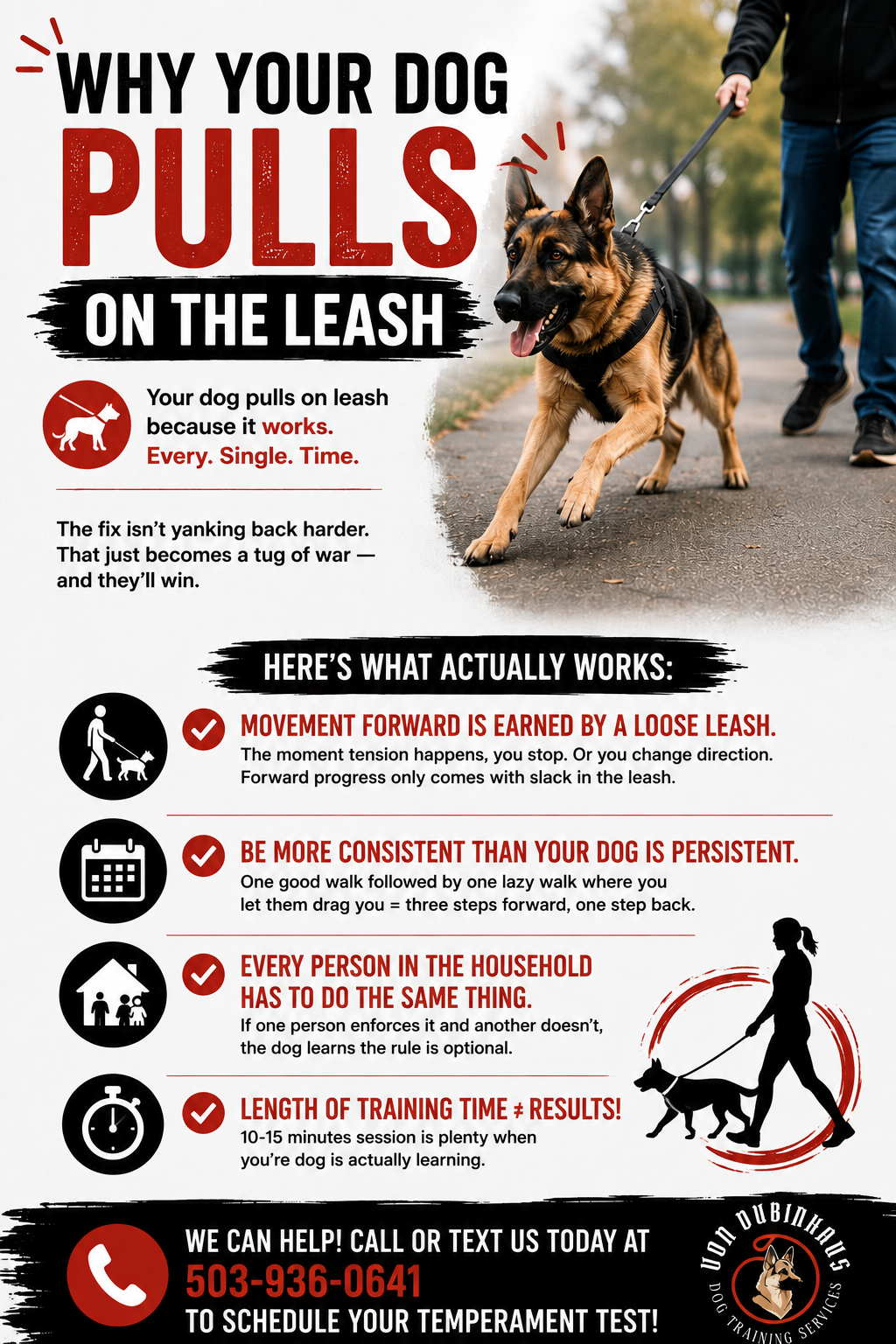
🦮 Movement Forward Is Earned by a Loose Leash
The moment tension happens, you stop. Or you change direction. Forward progress only happens with slack in the leash.
This retrains the fundamental equation your dog has learned. Right now they believe pulling = forward movement. You're teaching them the opposite: a tight leash stops progress, a loose leash creates it. Every single rep reinforces one version or the other — which is why consistency matters so much.
💪 Be More Consistent Than Your Dog Is Persistent
One good walk followed by one lazy walk where you let them drag you = three steps forward, one step back.
Dogs learn through repetition and pattern. If the rule is "pulling works sometimes," they will pull every time and wait to see if this is one of the times it works. The rule has to be the same on every walk, with every person, in every environment. That's what makes it real.
🧑🧑🧒🧒 Every Person in the Household Has to Do the Same Thing
If one person enforces it and another doesn't, the dog learns the rule is optional.
This is one of the most common reasons leash training stalls — the dog has figured out that the rules depend on who's holding the leash. Kids, partners, dog walkers, whoever takes them out: everyone needs to be working the same way. One exception unravels a lot of progress.
⏱️ Length of Training Time ≠ Results
A 10–15 minute session where your dog is actually learning beats an exhausting hour where you've both checked out. Keep it short, keep it focused.
Dogs learn best when they're engaged and not overtired. Long sessions lead to frustration for both of you and sloppy reps that reinforce the wrong things. End on a win, not on exhaustion. Short and frequent beats long and occasional every time.
🛑 Add Consequences, Not Just Rewards
This is where I'll probably say something some people don't want to hear: for a lot of dogs, rewards alone aren't enough to break a deeply ingrained pulling habit, especially in high-distraction environments.
If a dog has been pulling on leash for two years and the smell of that fire hydrant is the most compelling thing in their world, a treat in your hand is not going to outcompete it. You need to also communicate clearly that pulling is not the path forward — a leash correction, delivered calmly and at the right moment, does that. Not harsh, not angry. Clear.
Balanced training is not about punishing dogs. It's about giving them complete information: here's what gets you where you want to go, and here's what doesn't. Dogs who understand both sides of that equation learn faster and retain it better.
Interested in working on leash manners with Paul?
What Loose Leash Walking Actually Looks Like
I want to set realistic expectations here, because "loose leash walking" means different things to different people.
A loose leash doesn't mean your dog walks in a perfect heel with eyes locked on you the whole time. That's competition obedience — not what most owners need for daily life.
A loose leash means:
The leash has slack in it most of the time
Your dog checks in with you regularly instead of constantly straining forward
When something exciting appears, your dog notices it — but then comes back to you rather than launching themselves at it
You can redirect your dog's attention when you need to
That's achievable for almost every dog. But it takes real training, not just equipment changes.
Portland-Specific Notes
A few things that make leash manners especially important in Portland:
🪵 The trail system. Powell Butte, Springwater Corridor, Forest Park — these are beautiful, and they're full of other dogs, bikes, joggers, and wildlife. A dog who can't hold it together on leash is a dog you can't take to the places that make living in the Pacific Northwest so great.
🐾 Tight sidewalks. Portland neighborhoods have narrow sidewalks, and in summer they're busy. A dog who pulls you into every passer-by or lunges at every dog coming the other direction makes city walking miserable.
🏞️ Off-leash areas. Here's something people don't always connect: a dog with poor leash manners usually has a recall problem too. The same communication breakdown that causes pulling — the dog has learned that their agenda takes priority over yours — shows up in both behaviors. Fixing one often helps the other.
When to Call a Trainer
If you've been working on leash pulling for more than a few weeks without real progress, or if the pulling is combined with reactivity — your dog is also lunging, barking, or fixating on other dogs or people — it's time to get a professional read on what's happening.
Leash pulling combined with reactivity is a different problem than simple pulling. The emotional state driving it is different, and the approach needs to account for that. Treating it like a manners issue when it's actually an anxiety or arousal issue is one of the most common reasons training stalls.
A temperament test at Von Dubinhaus is $45 and takes about 45 minutes. You'll leave with an honest assessment of where your dog is and what it will actually take to get them where you want them to be.
A Quick Drill to Try This Week
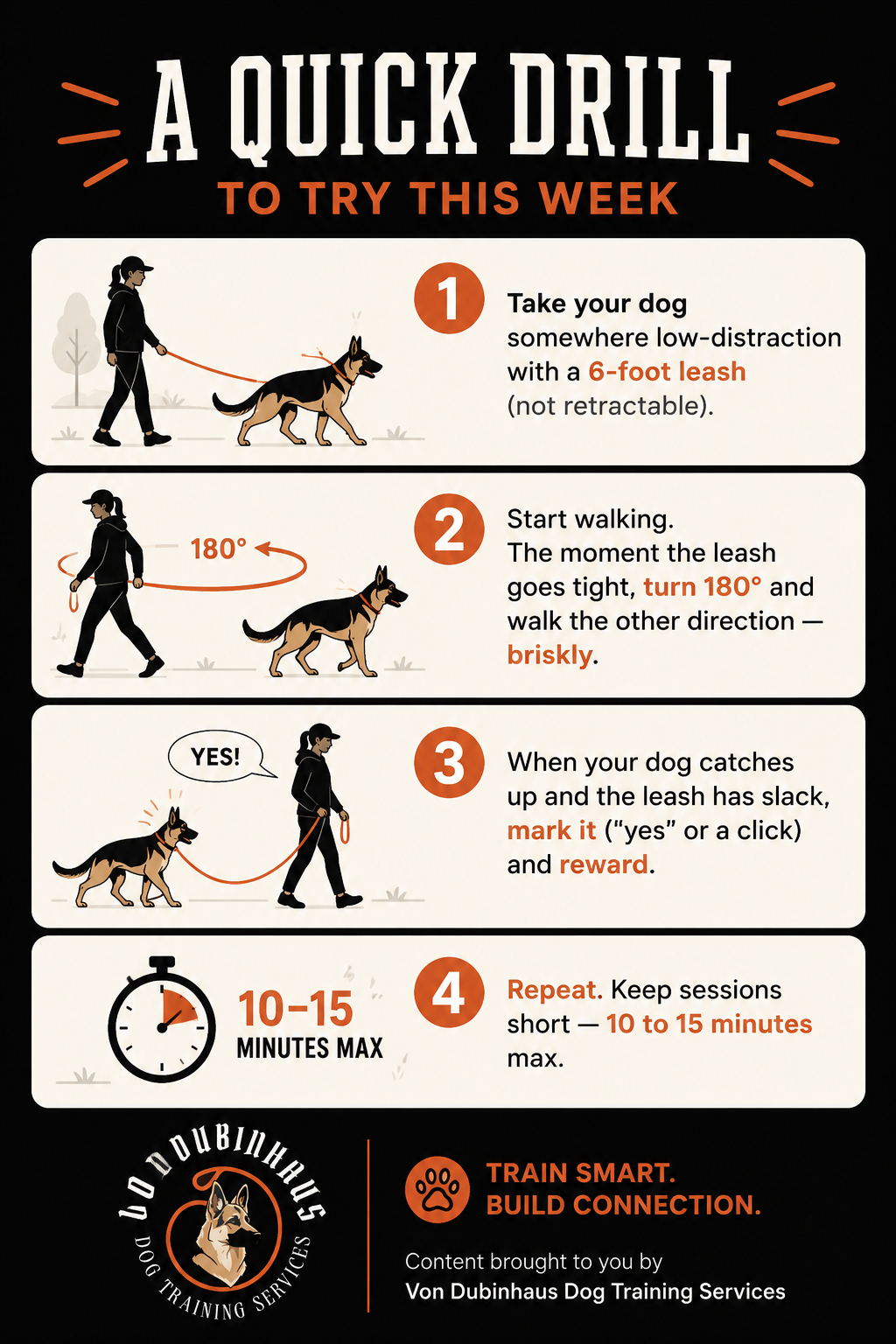
If you want to start working on this before you book anything, here's a simple drill:
Take your dog somewhere low-distraction with a 6-foot leash (not retractable).
Start walking. The moment the leash goes tight, turn 180° and walk the other direction — briskly.
When your dog catches up and the leash has slack, mark it ("yes" or a click) and reward.
Repeat. Keep sessions short — 10 to 15 minutes max.
You're teaching your dog two things: leash pressure means come back toward me, and staying near you is worth their while. That's the foundation.
It won't fix a year of pulling in one session. But done consistently, you'll start to see a different dog on the other end of that leash.
FAQ: Leash Pulling in Portland
What's the best tool to stop my dog from pulling?
There's no single tool that fixes pulling — it's a training problem, not an equipment problem. A prong collar, slip lead, front-clip harness, or flat collar can all be used effectively or ineffectively depending on how they're applied. The tool matters less than the training behind it.
My dog only pulls toward other dogs. Is that still a leash pulling problem?
It can be — but it might also be reactivity or over-arousal around other dogs, which is a different issue. If your dog is pulling and also vocalizing, lunging, or losing their ability to focus on anything else, that's worth a professional assessment.
How long does it take to train loose leash walking?
For a dog without reactivity, most owners see meaningful improvement in 2–4 sessions with consistent practice in between. For dogs who've been pulling for years or who have reactivity layered in, it takes longer. The good news: it's one of the most solvable problems in dog training.
My dog walks fine on a harness but pulls on a flat collar. Which should I use?
Use whichever allows you to communicate most clearly and safely — but don't mistake "the harness stops the pulling" for "my dog learned not to pull." If you want the behavior to transfer across equipment and environments, that requires actual training, not just switching tools.
Can I fix leash pulling without treats?
Yes. Treats are useful but not required. What's required is clear communication — the dog needs to understand what you want, and there need to be consequences (positive and corrective) that make your preferred behavior the obvious choice. Some dogs are barely food-motivated. We work with what each dog responds to.
Is leash pulling ever a sign of a bigger problem?
Sometimes. If pulling is accompanied by high arousal, fixation on triggers, or an inability to settle on leash even in calm environments, there's usually more going on than manners. That's worth looking at more closely.