Inside the Von Dubinhaus Temperament Test: What I'm Actually Looking For
Every dog that comes through my door starts the same way.
Before we talk packages. Before I give you a single piece of advice. Before anything else — we do a temperament test. It's not a formality. It's not a box I'm checking. It's the most important 45 minutes we'll spend together, because everything that comes after depends on what I learn in those three parts.
This month, I'm waiving the temperament test fee entirely when you sign up for a Core Package or Lifetime Training at the same time. I'll tell you more about that at the end. First, let me show you exactly what this test is — because I think once you understand what I'm actually reading, you'll understand why it matters so much.
It's Not About Pass/Fail
The first important thing to note: the temperament test is not about whether your dog is "good" or "bad." I'm not going to tell you your dog failed. That's not what this is.
What I'm doing is reading your dog as an individual — how they process new environments, how they respond to pressure, how they handle uncertainty, how they relate to other dogs. Every dog has a temperament. I'm not judging it. I'm understanding it.
That understanding is what lets me build a training plan that actually works for your dog, not a generic template I hand to everyone who walks in.
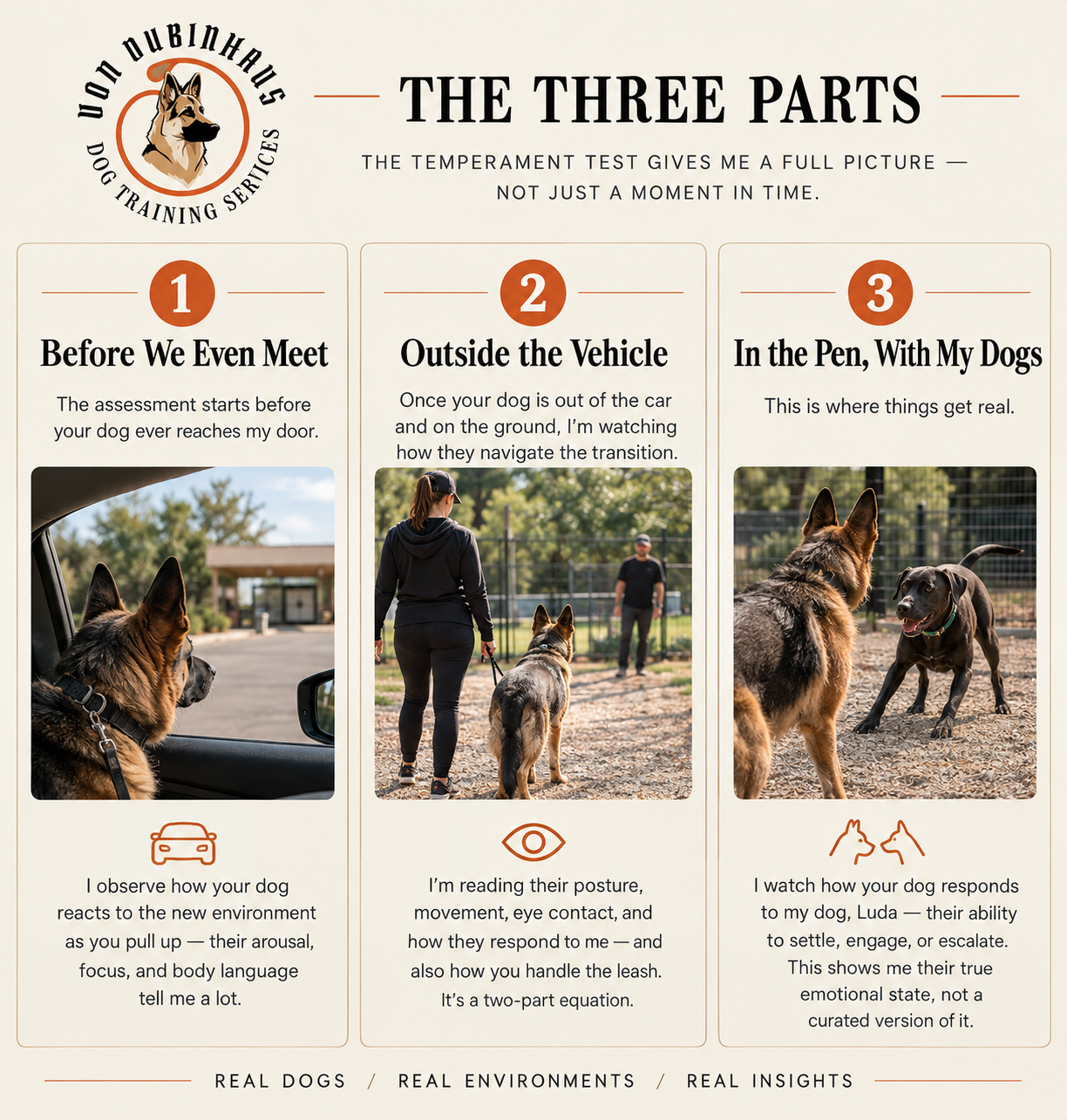
Part 1: Before We Even Meet
The assessment starts before your dog ever reaches my door.
When you pull up in your car, I'm watching. A dog who becomes highly agitated as the vehicle enters a new territory — who's escalating before you've even opened the door, fixating on the environment, scanning for threats — is telling me something. That level of territorial drive or environmental sensitivity is information. It tells me something about the dog's baseline arousal and how they experience new places.
Some dogs are loose and curious as you pull up. Some are alert but manageable. Some are already revved well past a calm baseline before we've said hello. All of that is data.
Part 2: Outside the Vehicle
Once your dog is out of the car and on the ground, I'm watching how they navigate the transition.
This is a dog in a genuinely new environment — new smells, new sounds, new person in front of them. What do they do? Do they move toward me with curiosity or hang back with uncertainty? Do they scan constantly, or can they settle into the moment? How do they handle the low-level unpredictability of a new space?
I'm reading posture, movement, eye contact patterns, how they respond when I introduce myself. A dog who's shut down is different from a dog who's reactive — and both are different from a dog who's loose and engaged. Each picture points me in a different direction when it comes to approach.
I'm also watching you in this moment. How you handle the leash, how your dog reads your energy, whether there's a communication gap between the two of you — that matters too. Training is always a two-part equation.
Part 3: In the Pen, With My Dogs
This is where things get real.
Once we're inside, I bring out my own dogs — my girl Luda is part of this process. I want to see how your dog responds to another dog in a controlled, structured environment.
What I'm looking for: Does your dog fixate hard, or can they settle? Do they escalate when the other dog approaches? Do they engage appropriately, or does the arousal spike in a way that suggests the underlying emotional state is something we need to work with? Can you redirect your dog's attention, or have they completely checked out of their relationship with you?
Luda is calm. He's experienced. He's not going to provoke anything unnecessarily. Which means if your dog reacts, I can be confident I'm seeing something genuine — not a response to another dog's provocative behavior.
This third piece is often the most revealing, especially for owners who've told me their dog is "fine with dogs it knows." The temperament test gives me a read on what's actually happening, not a curated version of it.
One Thing I Tell Almost Every Owner Before They Come In
Most dogs perform better than their owners’ expectations.
I mean that literally. The dog you've been managing, apologizing for, stressed about — that dog shows up and surprises you. They hold it together better than they do at home. They take in the new environment without completely losing their mind. They respond to me in ways that catch you off guard.
This happens more often than not, and I think it's worth saying out loud, because a lot of people show up to the temperament test braced for embarrassment. They've been living with the worst moments — the lunge at the neighbor's dog, the incident at the park, the thing that happened that they're not sure they should even mention. They assume that's what I'm going to see.
Sometimes I do. But often, what I see is a dog who was struggling in an environment without enough structure, without clear communication, without someone who knew how to read them — and who, given even a small amount of that, steps up.
That doesn't mean the work is easy. It doesn't mean the problems aren't real. But it does mean that the picture you've built of your dog in your head — often at their absolute worst — usually isn't the full picture. The temperament test is often the first time an owner sees their dog through a different lens.
Come in with whatever you've got. That's what I'm here for.
What You Leave With
After all three parts, we sit down and talk about the assessment. Plainly.
If the issue is behavioral — a training gap, a manners problem, a handler communication issue — I'll tell you that. If there's an emotional component driving what you're seeing — anxiety, fear, arousal, a history that left a mark — I'll tell you that too. And we’ll discuss what I think it will take to address it, including an honest estimate of timeline and effort.
I've done this long enough that I can tell within the first session whether a dog is going to turn around fast, take sustained work, or present a longer-term management challenge alongside training. I'd rather give you the real picture than a hopeful story that doesn't hold up.
Some of the most dramatic turnarounds I've seen came from dogs who looked like lost causes in Part 1 of their temperament test. Some of the easier-seeming dogs turned out to have layers that took longer to work through. The test tells me where we're actually starting — not where I hope we might be.
October Promo: Test Fee Waived
This month only, I'm waiving the $45 temperament test fee when you sign up for a training program at the same time.
Here's what that looks like:
Core Package — Eight one-hour sessions at $800. Start here if your dog has real behavioral issues we need to work through: reactivity, aggression, anxiety, leash problems that haven't responded to anything else. Eight sessions gives us the runway to do real, lasting work.
Lifetime Training — $2,500. Flat. No exceptions. This is the option for owners who want unlimited sessions for the life of their dog — regardless of how challenging the dog is. I don't charge more because a dog is harder. The $2,500 covers everything. Come as many times as you need for as long as you own that dog. For complex cases, it's often the most cost-effective path by a wide margin.
When you sign up for either program this October, the $45 temperament test fee is waived. The test still happens — It’s not skipped. It’s included within the training program. If you decide to sign up for the Lifetime Training after eight sessions, the $800 is deducted from the Lifetime Training price.
To schedule, call or text (503) 936-0641 or reach out through vondubinhaus.com/contact.
A Word on the Why
I've seen the alternative. Trainers who book a first session without ever really reading the dog. Generic programs built on assumptions that may or may not match your animal. Advice given confidently before anyone really understands what's driving the behavior.
I don't work that way, and I can't work that way.
Every dog I've trained across 25 years has been an individual. The plan that worked brilliantly for a German Shepherd with territorial reactivity was the wrong plan for an anxious rescue with a bite history even if the behaviors looked similar from the outside. The diagnosis has to come first.
The temperament test is how I do my job right.
FAQ: The Von Dubinhaus Temperament Test
What does a temperament test actually tell you?
It gives me a read on your dog's baseline reactivity level, environmental sensitivity, how they respond to unfamiliar people and other dogs, and how effectively you and your dog communicate with each other. That picture is the foundation for everything we do after.
Is the temperament test just an observation, or do you work with my dog?
Both. I observe first — how your dog arrives, how they move through a new environment. Then I work with your dog directly to feel how they learn and respond to structure. That hands-on read is part of what I'm assessing.
What if my dog reacts badly during the test?
That’s good. I want to see the real dog. A dog who's on their best behavior in a new place sometimes masks exactly what we need to understand. Reactivity, anxiety, over-arousal during the test — that's information, and it's useful.
Do you work with dogs who have a bite history?
Yes. Bite history doesn't automatically end the conversation — it adds context. Understanding why the bite happened is the starting point. Come in and let me assess.
What's included in the October promo?
The $45 temperament test fee is waived when you sign up for the Core Package (8 sessions, $800) or Lifetime Training ($2,500 flat) in October. The temperament test still happens — it's just included at no additional cost when you commit to a training program at the same time.
What makes Lifetime Training worth it?
No per-session fees. No expiration. No premium pricing for challenging dogs — the $2,500 rate is the same regardless of how hard or easy your dog is to work with. For any dog that's going to need ongoing work, or any owner who wants open access to come back whenever something new comes up, it's often the best value long-term.